Saturday, March 23, 2019

Sunday Program

Legrand's Outside Seam Grip


Gripping: Ugo Legrand's sleeve pin strategies (30 mins)

- Forearm sleeve pin
- Outside seam pin

Newaza: Osaekomi Turnovers (1 hour)
- Matsumoto Roll
- Oshima Roll
- Fallon Roll (revision)
- Arm Roll (revision)

Tachi-Waza (2 tracks) (45 mins)

- Competition
- Grading

Randori (45 mins)
- Mindset (8 modes of Randori)
- Newaza
- Tachi-Waza

Friday, March 22, 2019

A hive of activity

Buzz, buzz, buzz...

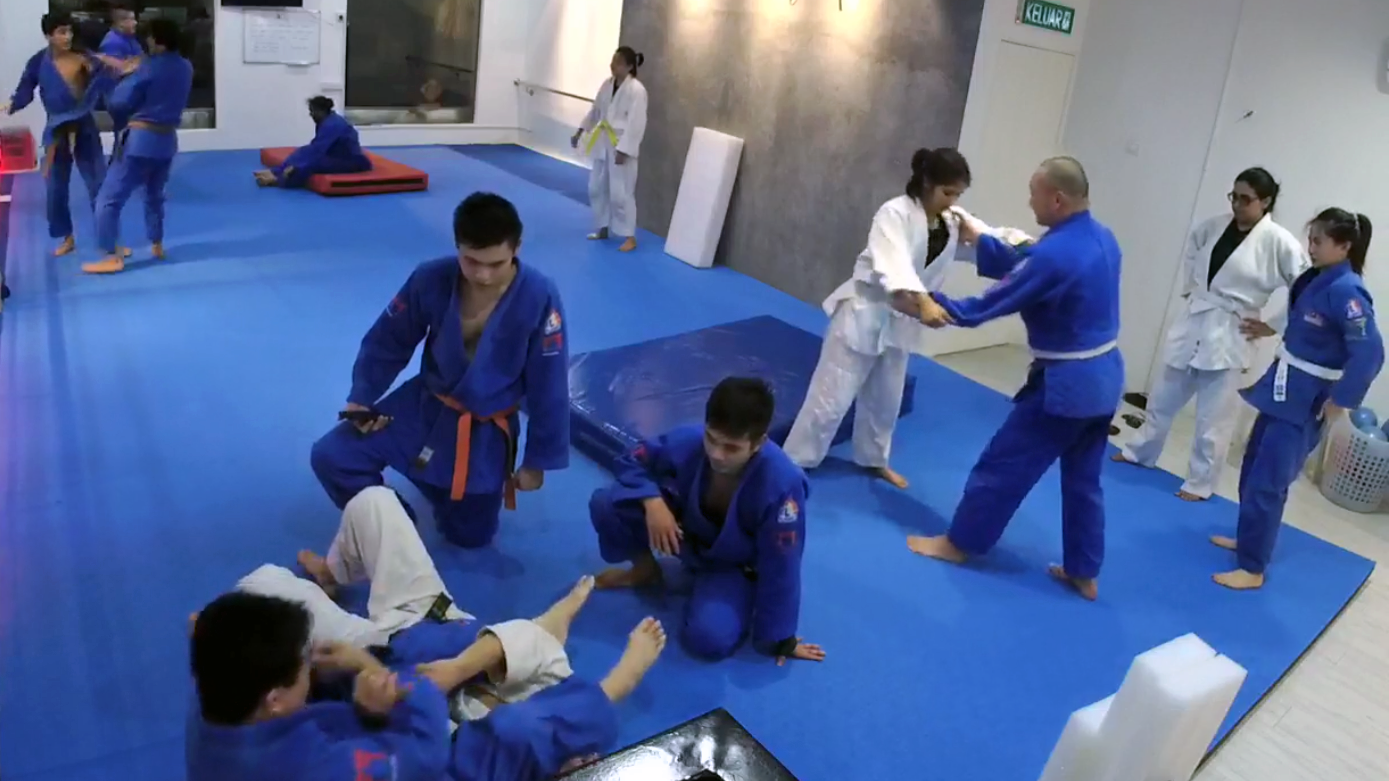
Our turnout hasn't been huge lately. Last night, we had 13 people on the mat. Nothing to shout about but our dojo was still a hive of activity. You can see two distinct tracks going on. In the foreground, players are preparing for their belt grading. In the background, players are preparing for competition.

We've been running dual-track trainings for some time now. They work well for us as this allows us to cater to the different needs of different players. Some are more focused on competition while others prefer to focus on grading. Dual tracks allow us to serve both these groups within the same session.

Thursday, March 21, 2019

Friday Session

Fallon Roll

Gripping Exercises (20 mins)


Newaza: (40 mins)

- Alligator Roll
- Arm (Belgian) Roll
- Fallon Roll
- Oshima Roll

Tachi-Waza (2 Tracks) (20 mins)

- Grading (yellow belt)
- Competition (tokui-waza)

Randori (40 mins)
- Newaza
- Tachi-Waza

Tuesday, March 19, 2019

Wed Extra Training

1. Gripping Drills
- Korean Shake
- Sleeve Control
- High Grip Break

2. Newaza:
- Alligator
- Knee Roll

3. Tachi-Waza
- Seoi-Overshoot
- Tomoe-Overshoot

4. Transitions (Ground to Standing)
- Sumi-Gaeshi
- Uchimata
- Osoto

A picture of happiness

A snapshot of a happy moment.

When we think of judo training, the words: "grueling", "tough", "exhaustion" come to mind. But not "happiness".

Yet, happiness is the foremost word on my mind when I look at the snapshot above of a moment on Tuesday night which shows players in the background training for their belt grading and those in the foreground training for competition.

My goal for KL Judo Centre is simple. I want to provide a good training environment for students and working adults to come together for judo.

A good training environment requires many factors:
a) Sound instruction
b) Players of varying sizes and weights
c) A critical mass of bodies on the mat
d) Top-notch infrastructure

We've got all of that at KL Judo. And that's a reason to be grateful and happy.

Monday, March 18, 2019

If there's a will, there's a way

Terence is one of my students who started judo at the end of last year, at the age of 50. He was not very confident at first and the fitness regiment required for judo was something he was not used to. But he's stuck with it and now, several months later, not only has he got more skills but he's also fitter. And, I'm sure, he's enjoying judo a lot more because of both those factors.

A key success factor in judo is simply sticking with it. When you first start judo, it can be very frustrating because you don't have any techniques and your fitness level is probably below those who have been training for some time already. Even if you are a generally very fit person, the anaerobic nature of judo is something that aerobically fit people are not used to. And most people who are "fit" are aerobically fit, not anaerobically so.

So it takes time to get used to judo fitness and it takes even longer to develop skills and techniques. If you don't stick with it, how are you ever going to get there? So, it's important to stick with it.

Terence could have very easily given up in the first month. Many beginners do. But he stuck with it. I'm sure at first, judo training was not that enjoyable for him. It probably was interesting because he's constantly learning new things but if you don't have fitness and don't have technique, it is hard to find the training enjoyable. It only starts becoming more fun once you've been in it for a month or two. Of course the longer you do it, the fitter and better you get and the more enjoyable training becomes.

This past Sunday, he was not supposed to be at training. He told me after Friday's training that he would have to give Sunday a miss because he would be in Johor Baru over the weekend. Then, on Saturday evening he sent me a message saying that he plans to drive back Sunday morning and if he can make it back in time for judo session he would like to attend, even though he might be a little bit late.

I told him that would be great and if he has to be 30 minutes late, so be it. Just come for training. He said he would. As it turned out, not only did he show up, he was there before class started and he stuck with the training for the entire three hours! I know how tiring it is to be driving just for an hour. Imagine driving all the way from JB to KL and then coming straight for judo. That's dedication. That's what the fighting spirit of judo is all about.

When people think of fighting spirit, they often think in terms of the aggression one shows during a randori or a shiai. That is one aspect of fighting spirit. But there's more to fighting spirit than just how you fight. It's also about your commitment and dedication to training. Some people will skip training with the flimsiest of excuses. Some people will come for training even if they have to drive from another state to do so.

Speaking of driving from another state, Nigel, one of our black belt instructors, used to drive all the way from Melaka to attend our trainings when we were based in Cheras. At times he would stay overnight in KL but there were days when he would drive back to Melaka after training. Melaka may not be JB but it's still two hours away. To drive all that distance to attend judo training takes commitment. It takes fighting spirit.

Terence reminds me of Mark Law, a newspaper editor whom I met at the Budokwai when I was a competitor in the early 1990s. Mark was 50 years old when he started judo as a white belt. The last time I visited the Budokwai, in 2011, Mark was still training and was, of course, already a black belt.

It must not have been easy for Mark in the early days when he was a white belt, at the age of 50, training among some of the toughest players in London. But he stuck with it and eventually got his black belt. He even wrote a book about judo called The Pyjama Game.

Tuesday's Program

Teaching two tracks is challenging when there's only one instructor on the mat but sometimes that's the situation you find yourself in. Dave is not available today and Nigel is out of the country. But training goes on.

I could easily say, today we will have just one track and everyone does the same thing. But that would be taking the easy way out. With a little creativity and a lot of planning, it's possible to have two tracks (grading training and competition training) so that your players are better served.

First of all, it helps if you know who exactly is coming for training. On paper, we should know because we use an app-based booking system where players are supposed to indicate the days they will be attending training sessions.

There are a few players who like to wait until the very last moment to do their booking. It could be that some of them might not know if their schedule permits but that's usually not the case. Usually, it's just plain old procrastination.

Of course those who do last-minute booking will still be allowed to participate but they will just have to tag along and do whatever has been planned for those who did bother to do a booking.

When I plan a class, I don't just think in terms of what to teach and what drills the players should be doing but also who their training partner for the day should be. There may be two broad groups (grading and competition) but I try to customize the training down to the individual.


This is particularly so with the competition players, who do require individual attention but in some cases this is needed for players training for grading too. A person could be particularly weak in a specific technique. If so, I would ask them to spend more time on that technique and identify the best person to be their partner for that exercise.

So, knowing who is coming is important for my planning. It serves the player well for them to let me know in advance if they are coming for training. But not all do that. It's their loss. The ones who want to benefit more for each training session will book in advance because they understand that is how they will get training customized to their needs.