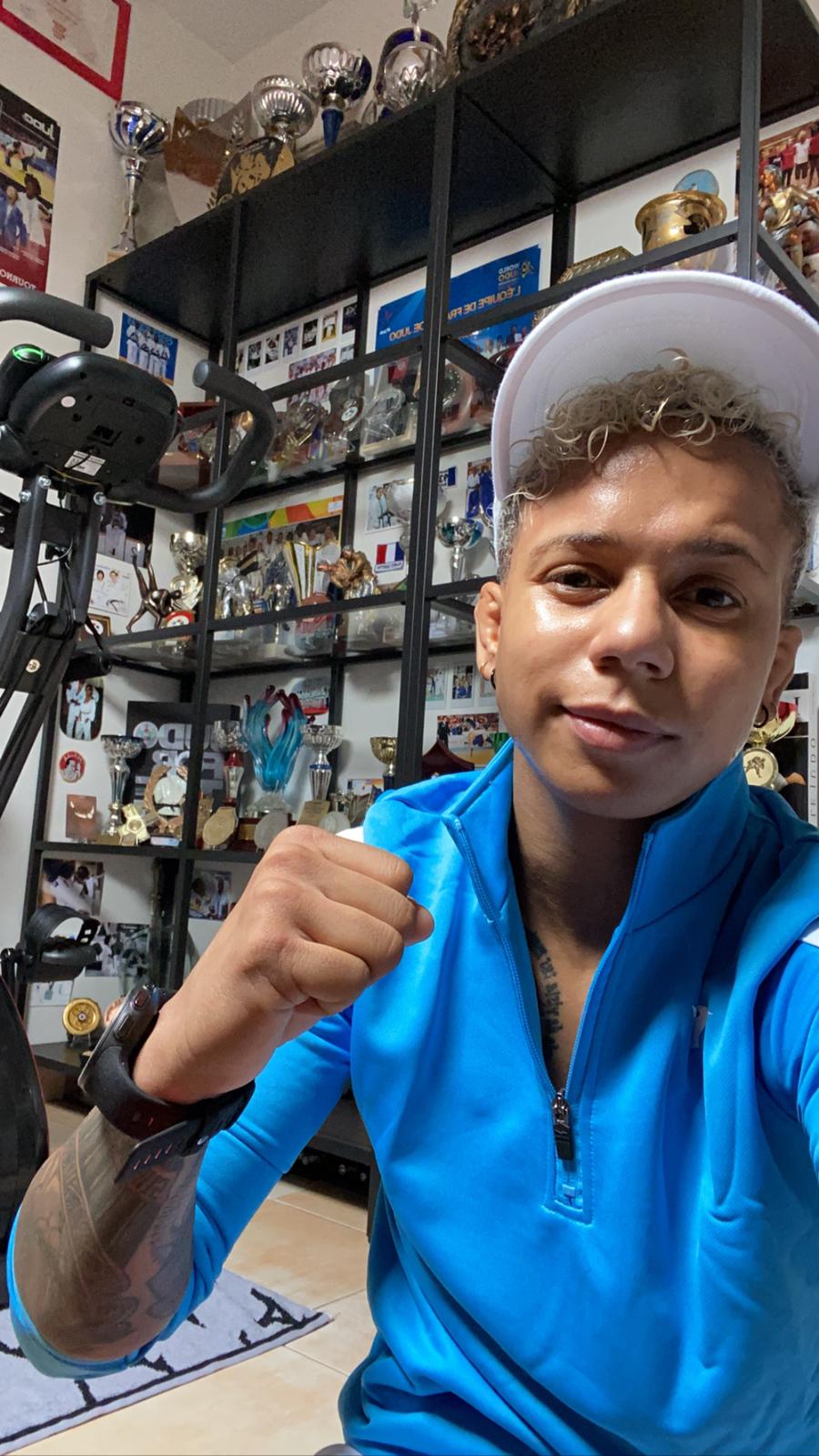
Amandine Buchard of France is the current World Ranked No. 1 player at -52kg. She is a World and European medalist and has won the gold medal in seven IJF World Tour events (two Grand Slams and five Grand Prix). She is currently in lock-down in her apartment in Paris.
Q: With France in a tight lock-down, are you able to do any kind of judo training at all?
A: No, all judo clubs are closed, as is INSEP, our national sports institute. It’s not possible to do any judo training because we are in a kind of quarantine. I don’t go out of my house, not even for a run. The only time I ever set foot outside is to take out the trash and to go to the supermarket or pharmacy.
Q: How well have you adapted to the lock-down?
A: I cope as best as I can. At home I have a guest room which I have converted into a gym. I ordered some fitness equipment from Amazon so that I can still do some form of training and keep in good physical condition. Otherwise, I would just go crazy.
Q: When was the last time you did some judo?
A: The last time I did judo was a technical session at INSEP with Mélanie Clément, our -48kg player, and our coach Lucie Decosse on March 12. As for training in a group setting, it was at my club on March 4, in preparation for the French Team Championship which was to take place on March 7 and 8. It was cancelled of course.
Q: Are you watching lots of judo videos while in isolation?
A: I watch a lot of judo videos because I like watching ippons from various tournaments. But I don't do a lot of video analysis of my opponents… almost not at all.
Q: Don’t you want to analyse how someone like Abe Uta fights?
A: I might watch a few of her fights but in general I don’t like basing my judo on what the other player is doing and then trying to adapt to their judo. I prefer to work on my own judo.
Q: What is a typical day for you like before and after the lock-down?
A: Before all of this happened, a typical day would have me doing physical fitness training in the mornings. I would usually stay at the training centre to eat some food and chill with my friends until it's time for the evening session, which is focused on randori. When that is done, I would either go out with friends or we might head to my home and relax – have some Apéro, play some Nintendo Switch or watch something on Netflix. But nowadays, while in isolation, my schedule is completely different. I don’t bother to set my alarm anymore. I wake up when I wake up. I motivate myself to train. Then, I eat and just spend a lot of time on the sofa thinking about nothing in particular. Sometimes I’ll take a nap or play Nintendo or do some spring cleaning. It can get quite depressing. I feel like a lion caged inside a box.
Q: Are you keeping in touch with your teammates and coaches?
A: Yes, I stay in contact via WhatsApp and Instagram with my coaches, teammates and family members. We call each other, we send funny videos and photos to make each other laugh… anything just to make our days a little brighter.
Q: You have already qualified for the Olympics. How will you feel if Tokyo 2020 is cancelled or postponed?
A: Just thinking about it breaks my heart. The Olympics is my biggest dream, my reason for living. I had missed the 2016 Rio Olympic Games because I was unwell at the time. I don't want to miss another Olympic Games.
Q: What was wrong with you during the Rio period?
A: You could say my whole body was destroyed at the time. I had small injuries everywhere. I was also in a very deep depression, so much so that I had to see a psychologist. The pressure of being a top athlete coupled with the drastic dieting I had to do to make weight was too much for me. I had developed eating and sleeping disorders, I had behavioral and memory issues. It started in 2015 and it took about two years before I could heal myself.
Q: Kaori Yamaguchi, a member of the Japan Olympic Committee has said that the Olympics should be cancelled because it would put players at risk. Would you be willing to take that risk?
A: I am aware that the health and safety issue is much more important than the Olympic Games. But I can tell you this, if they decide to hold the Olympics as scheduled, I would go.
Q: Your judo has evolved a lot over the years. These days you do a lot of newaza with that special turnover of yours. How did that come about?
A: Yes, my judo has evolved. I came to specialize in newaza thanks to my time spent at the International Judo Centre in Valencia, Spain in 2016, when I went there to recuperate after my physical and mental breakdown. I can’t thank Sugoi Uriarte and Laura Gomez enough, as well as their entire club, for welcoming me into their judo family. It's what saved me, quite frankly.
Q: So, you didn’t invent that turnover technique?
A: No, no… I learned that technique from Sugoi. Actually, many Spanish judokas do it: Ana Perez Box, another -52kg player, does it. So does Julia Figueroa, a -48kg player. Daniel Perez Roman, a -66kg player also likes to do this technique.
Q: You’re able to pull off some amazing ashiwaza from time to time. How did you train to be so good at timing?
A: To be honest, I don’t do any special training for timing. I do ashiwaza based on instinct and feeling. A lot of my judo is based on feeling rather than on rehearsed drills. I’m a very instinctive player.
Q: For tachi-waza your main technique these days seems to be drop kata-guruma to the side. How did you pick up that technique?
A: That’s something I’ve been doing for a long time now. I first learned how to do it by asking some of the boys during my cadet years. At first, I couldn’t make it work. I would hurt my head each time I tried it. But eventually I got it and now I can do it from all kinds of angles and all kinds of positions. It’s my most effective technique.
Q: Isn’t that the throw you used to catch Uta Abe in the final of the 2019 Osaka Grand Slam?
A: Yes, that’s right!
Q: After beating her in Osaka last year, you lost to her in the final of the recent Dusseldorf Grand Slam. What happened there?
A: Abe is my greatest rival. She’s really way up there. But I feel I’m gradually catching up with her. In Osaka, I was very motivated to win and my trusty kata-guruma came through for me. In Dusseldorf, I had just come out of a minor injury that I had picked up at a training camp in Austria. I nearly got eliminated in the earlier rounds. I eventually made it to the final but I felt like only 50% of my usual self, so I wasn’t able to fight well. I look forward to meeting Abe again, when I’m in better form.
Q: You’re only 24 but you've been fighting at a very high level for nearly a decade. Do you ever feel worn out?
A: Since young, I’ve had this strong determination to become the best. I really wanted to make my father proud because he’s everything to me. I found success in judo at an early age and joined the French Seniors Team as a teen. It's very punishing physically, training to be a top athlete but I don’t feel ready to stop yet. I won’t stop until I achieve my biggest dream, which is to win an Olympic gold medal.
Q: Any words of encouragement to other judo players around the world who are also stuck in a lock-down?
A: It’s important to follow the quarantine guidelines. The more serious and reasonable we are about this, the faster the situation will improve and things will go back to normal. Don’t be selfish, I know that it’s not easy to be in isolation. Look at me, I’m locked up in my apartment, alone, without a balcony even. It’s really not easy at all but I follow the rules because it’s for everyone’s good. Be strong and be united in this difficult time. We will all get through it.
And a special message from Amandine Buchard to the members of KL Judo Centre:
Q: With France in a tight lock-down, are you able to do any kind of judo training at all?
A: No, all judo clubs are closed, as is INSEP, our national sports institute. It’s not possible to do any judo training because we are in a kind of quarantine. I don’t go out of my house, not even for a run. The only time I ever set foot outside is to take out the trash and to go to the supermarket or pharmacy.
Q: How well have you adapted to the lock-down?
A: I cope as best as I can. At home I have a guest room which I have converted into a gym. I ordered some fitness equipment from Amazon so that I can still do some form of training and keep in good physical condition. Otherwise, I would just go crazy.
Q: When was the last time you did some judo?
A: The last time I did judo was a technical session at INSEP with Mélanie Clément, our -48kg player, and our coach Lucie Decosse on March 12. As for training in a group setting, it was at my club on March 4, in preparation for the French Team Championship which was to take place on March 7 and 8. It was cancelled of course.
Q: Are you watching lots of judo videos while in isolation?
A: I watch a lot of judo videos because I like watching ippons from various tournaments. But I don't do a lot of video analysis of my opponents… almost not at all.
Q: Don’t you want to analyse how someone like Abe Uta fights?
A: I might watch a few of her fights but in general I don’t like basing my judo on what the other player is doing and then trying to adapt to their judo. I prefer to work on my own judo.
Q: What is a typical day for you like before and after the lock-down?
A: Before all of this happened, a typical day would have me doing physical fitness training in the mornings. I would usually stay at the training centre to eat some food and chill with my friends until it's time for the evening session, which is focused on randori. When that is done, I would either go out with friends or we might head to my home and relax – have some Apéro, play some Nintendo Switch or watch something on Netflix. But nowadays, while in isolation, my schedule is completely different. I don’t bother to set my alarm anymore. I wake up when I wake up. I motivate myself to train. Then, I eat and just spend a lot of time on the sofa thinking about nothing in particular. Sometimes I’ll take a nap or play Nintendo or do some spring cleaning. It can get quite depressing. I feel like a lion caged inside a box.
Q: Are you keeping in touch with your teammates and coaches?
A: Yes, I stay in contact via WhatsApp and Instagram with my coaches, teammates and family members. We call each other, we send funny videos and photos to make each other laugh… anything just to make our days a little brighter.
Q: You have already qualified for the Olympics. How will you feel if Tokyo 2020 is cancelled or postponed?
A: Just thinking about it breaks my heart. The Olympics is my biggest dream, my reason for living. I had missed the 2016 Rio Olympic Games because I was unwell at the time. I don't want to miss another Olympic Games.
Q: What was wrong with you during the Rio period?
A: You could say my whole body was destroyed at the time. I had small injuries everywhere. I was also in a very deep depression, so much so that I had to see a psychologist. The pressure of being a top athlete coupled with the drastic dieting I had to do to make weight was too much for me. I had developed eating and sleeping disorders, I had behavioral and memory issues. It started in 2015 and it took about two years before I could heal myself.
Q: Kaori Yamaguchi, a member of the Japan Olympic Committee has said that the Olympics should be cancelled because it would put players at risk. Would you be willing to take that risk?
A: I am aware that the health and safety issue is much more important than the Olympic Games. But I can tell you this, if they decide to hold the Olympics as scheduled, I would go.
Q: Your judo has evolved a lot over the years. These days you do a lot of newaza with that special turnover of yours. How did that come about?
A: Yes, my judo has evolved. I came to specialize in newaza thanks to my time spent at the International Judo Centre in Valencia, Spain in 2016, when I went there to recuperate after my physical and mental breakdown. I can’t thank Sugoi Uriarte and Laura Gomez enough, as well as their entire club, for welcoming me into their judo family. It's what saved me, quite frankly.
Q: So, you didn’t invent that turnover technique?
A: No, no… I learned that technique from Sugoi. Actually, many Spanish judokas do it: Ana Perez Box, another -52kg player, does it. So does Julia Figueroa, a -48kg player. Daniel Perez Roman, a -66kg player also likes to do this technique.
Q: You’re able to pull off some amazing ashiwaza from time to time. How did you train to be so good at timing?
A: To be honest, I don’t do any special training for timing. I do ashiwaza based on instinct and feeling. A lot of my judo is based on feeling rather than on rehearsed drills. I’m a very instinctive player.
Q: For tachi-waza your main technique these days seems to be drop kata-guruma to the side. How did you pick up that technique?
A: That’s something I’ve been doing for a long time now. I first learned how to do it by asking some of the boys during my cadet years. At first, I couldn’t make it work. I would hurt my head each time I tried it. But eventually I got it and now I can do it from all kinds of angles and all kinds of positions. It’s my most effective technique.
Q: Isn’t that the throw you used to catch Uta Abe in the final of the 2019 Osaka Grand Slam?
A: Yes, that’s right!
Q: After beating her in Osaka last year, you lost to her in the final of the recent Dusseldorf Grand Slam. What happened there?
A: Abe is my greatest rival. She’s really way up there. But I feel I’m gradually catching up with her. In Osaka, I was very motivated to win and my trusty kata-guruma came through for me. In Dusseldorf, I had just come out of a minor injury that I had picked up at a training camp in Austria. I nearly got eliminated in the earlier rounds. I eventually made it to the final but I felt like only 50% of my usual self, so I wasn’t able to fight well. I look forward to meeting Abe again, when I’m in better form.
Q: You’re only 24 but you've been fighting at a very high level for nearly a decade. Do you ever feel worn out?
A: Since young, I’ve had this strong determination to become the best. I really wanted to make my father proud because he’s everything to me. I found success in judo at an early age and joined the French Seniors Team as a teen. It's very punishing physically, training to be a top athlete but I don’t feel ready to stop yet. I won’t stop until I achieve my biggest dream, which is to win an Olympic gold medal.
Q: Any words of encouragement to other judo players around the world who are also stuck in a lock-down?
A: It’s important to follow the quarantine guidelines. The more serious and reasonable we are about this, the faster the situation will improve and things will go back to normal. Don’t be selfish, I know that it’s not easy to be in isolation. Look at me, I’m locked up in my apartment, alone, without a balcony even. It’s really not easy at all but I follow the rules because it’s for everyone’s good. Be strong and be united in this difficult time. We will all get through it.
And a special message from Amandine Buchard to the members of KL Judo Centre:


