Wednesday, May 27, 2015

Wednesday 27/5/15 Session (Video)


For newaza, we worked on a highly unusual but very effective turnover called the Matsumoto Roll.


For tachi-waza, we worked one of the most popular contest throws today, the reverse seoi-nage.

Wednesday 27/5/15 Session (Hybrid Training)

Wednesday's session saw a small, dedicated group show up. A few beginners were there but mainly competitors. So, the focus was more on competition techniques. Jason was on hand to help out with the beginners.

I taught the players a very special osaekomi move that I've only seen Kaori Matsumoto do in competition. Interestingly, none of the other Japanese female players seem to have adopted this move. I showed the players some clips of Matsumoto doing this in international competitions and then I demonstrated it for them.

My elite players are very quick and picking up new moves. Here I am instructing Qaini on the proper gripping for executing this very unusual but very effective technique.

The main challenge the players had was in maintaining their grip during the execution of the move. It also requires a bit of flexibility to do this well.

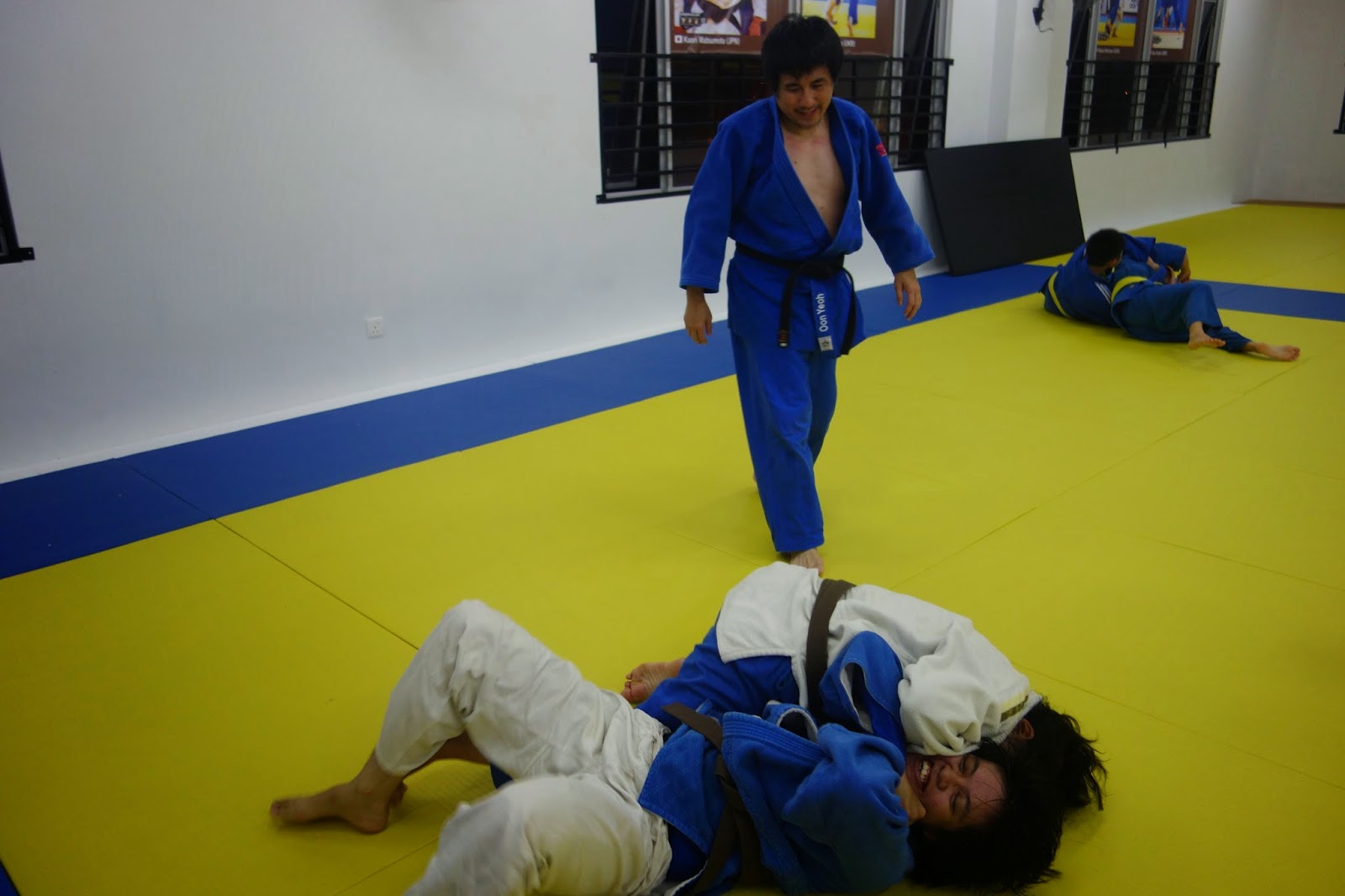
Once locked in, it's almost impossible for uke to break free. Try as they might, neither Qaini or Aishah were able to break free when the other hand them locked in this unusual hold.

Here I am instructing my young ones, Cherylynn and Suan Wah, on
how to secure the grip for the Matsumoto Roll.

After a few tries, they managed to get it right. Quick learners!

I also got the players to review and practice the "trap choke" which I had taught them on Monday.

I showed the players clips of the reverse seoi-nage in international competitions and all of them were pretty excited about trying it out. In fact, most couldn't wait to get started. It's such an unusual and dynamic throw.

Jason helps to correct Cherylynn's stance for executing the throw.

Aishah smashes Matthew to the crash pad with her right-handed
reverse seoi-nage. I later told her and Qaini they needed to learn
to attack with this throw to the left as well as they will face many
right-handed partners.

Monday, May 25, 2015

Monday 25/5/15 Session (Videos)

The players had a fun time doing some newaza randori. A lot of clubs don't seem to emphasize randori. I've come across so many players who say, "I hate newaza." At KL Judo we try to start with newaza to get the players used to the fact that newaza is important.


I taught them a European-styled ura-nage and they all managed to pick it up quite well.


And, of course, some randori.

Monday 25/5/15 Session (Hybrid Training)

Monday's group was smaller than Saturday's. There were a few beginners but many were competitors so it was a bit of a hybrid training where it was competition oriented but not overly so. I'll save the hardcore competition stuff for Saturdays which are dedicated specifically for competition training.

I showed them a video clip of Yasuhiro Yamashita's 1984 Olympic victory to educate them about judo competition history and to also motivate them a bit.

Today's newaza lesson is the "trap choke" -- something I learned from the LA Judo Training Centre in the early 90s. It's a deceptively effective strangle.

When done right, it ends up as both a strangle and an osaekomi that's really hard to escape from. 
As usual, I get everyone to work on drills, the best way for them to learn the technique. 
During the newaza drills, where players give resistance, you sometimes have bodies colliding. Here I am acting as a buffer.


See what a tangled mess it can be. But that's newaza!

For tachi-waza, I teach them a throw you don't see a whole lot of in Malaysia: Ura-Nage. But it's an important throw to counter against uchimata and other forward attacks since te-guruma is no longer allowed.

Securing the grip around the waist is important.

As is using one of your legs (the non-supporting leg) to aid in the lift as you thrown your partner backwards.

Showing Reza the right grip needed to make this technique work.

He's quite a natural at it. Actually quite a lot of the players picked it up really fast.

Showing Qaini the importance of securing the right grip to make this technique work. She's quite good at it too. She managed to fling many partners into the air and land on them. Luckily we have crash pads!

Suan Wah, our youngest elite trainee -- all 12 years of age. But he loves it. He enjoys training with the seniors and learning competition style techniques. By the time he's 17 or 18, he will be unbeatable at the senior level.

Nazrul from SBU paid us a visit. I had trained with him before. He's physically very strong and aggressive. Unfortunately there weren't any other black belts on the mat. But I gave him a good randori.

We had a fierce battle for grips.

Aishah and Qaini experimenting with grips during their randori.

I adopt a high right-hand grip against Qaini to get her used to fighting against players who might try to pull her head down.

I tell my players to follow into groundwork when the fight goes to the ground. And here, Qaini does just that. Many players like to just stand up after they end up on the mat. We want to discourage that and instead encourage them to finish up on the ground.

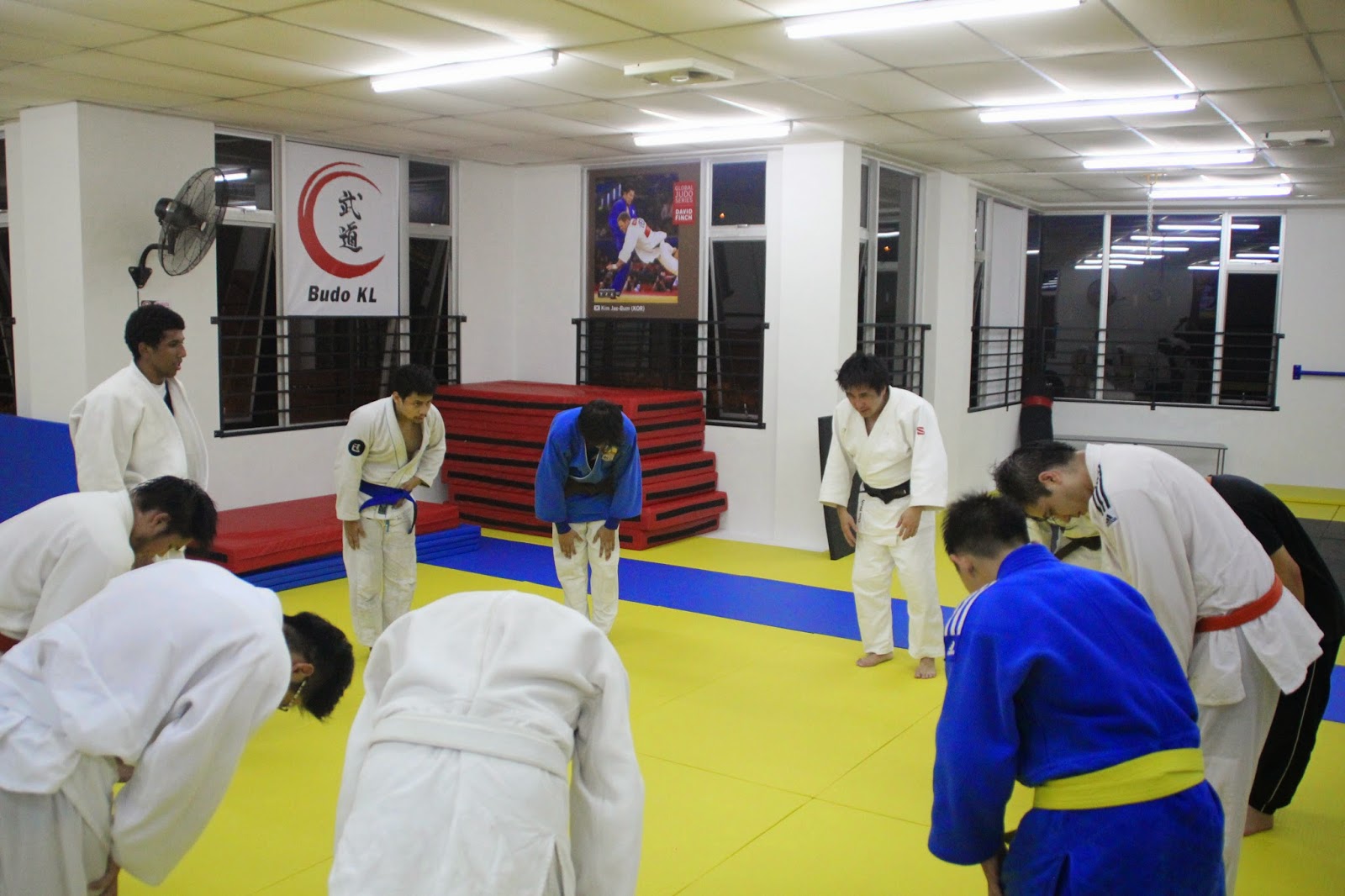
We end with our circular bow. It was a smallish group today but everyone had a good practice. The players said it was very intense. But that's how they like it!


Saturday, May 23, 2015

Saturday 23/5/15 Session (Videos)

We've been posting quite a lot of pictures of our training sessions but to really get a sense of what we do at KL Judo Training Centre, you'll have to see live action footage. On Saturday, for the first time we shot some video clips of our training, which also for the first time featured music -- both during the training and during the randori.

Although it's not common to play music during judo training in Malaysia, it's very common in Europe. It was a hit with KL Judo players who felt the music livened up the training and kept them motivated. My players said they wanted more of that so future trainings and randoris will feature music.

This is a clip of a drill we did to train players to avoid stepping out of the contest area. The attacker is to push against his partner and try to get him to step out. The defender's job is to stay within the contest area. After one song is over, the players switched roles with the attacker being the defender and vice-versa.


This exercise is more tiring than it looks. Everyone was exhausted after doing this.

One of the throws a lot of the players were interested in was the side takedown. I showed them a clip of the Laats brothers (Johan and Philip) who are considered the pioneers of the technique. They made this throw fashionable in the early 90s. Then I fast forwarded to today and showed them clips of Rishod Sobirov doing it in competition. After explaining the basics, I had them do this throw on crashpads (this is not the kind of throw that you can do uchikomi on).


The players managed to pick it up really well. The key to the throw is the grip and the entry.


Next, we have a clip of the players doing the side takedown, not as a throw but as a newaza movement that leads to osaekomi (yoko-shiho-gatame). We start with having them go through the motions, then with minimal resistance, some resistance and full resistance.

It took a while for the players to get used to this but in the end many got it to work.

The final clip we have for you is our free-flowing randori session, which was set to music of course. The players fought hard, bearing in mind that they had been training for slightly over two hours already by the time we got around to randori, which lasted for about another 45 minutes.


At KL Judo, we are big into randori which we think is the most realistic way to learn.

Saturday 23/5/15 Session (Open Training)

What a fantastic session we had today -- the best yet since our dojo opened its doors May 11. We had several guests from Sekolah Bintang Utara, one of the few high schools that actually has a competition judo program. We also had several black belts visiting us for the first time, helping out with the training and providing good randori experience for the colored belts.

There were a few beginners present but it was largely a competitors' training session. I came prepared to conduct a general session and a competition session depending on the make up of the crowd. Since over 80% of the players present were competitors, I angled the session towards competition.

Birthday girl Shen is still on crutches so she couldn't train, which is such a shame because there were many competitive girls on the mat, which is a rarity. But she unexpectedly received some birthday flowers, so that's some consolation. :)

Ms Jey, the teacher in charge of judo at Sekolah Bintang Utara (SBU) dropped by to observe the training and she brought with her some of her top players to try out the training.

Some of the girls getting ready for the start of training by doing a bit of stretching and warming up.

We had some beginners  so some of our senior players helped them learn how to do forward rolls.

The rest did moving uchikomi to get the blood flowing and get themselves ready for a good session.

At KL Judo we use video extensively as a training aid and as usual, we start the session watching some judo videos.

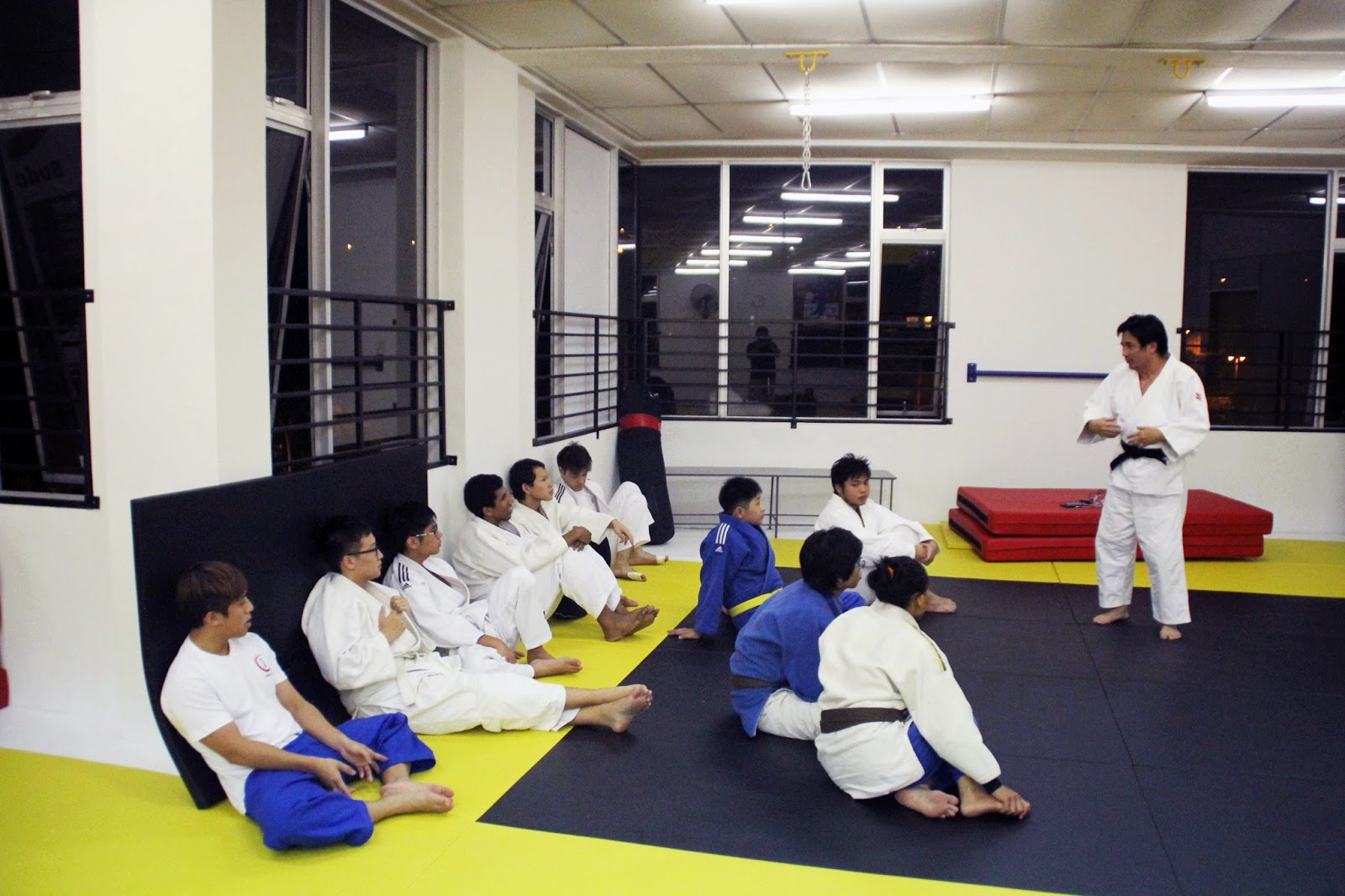
I explain to the players the importance of drills and familiarizing themselves with the current IJF rules so that they don't lose out strategically. I showed them some videos of top players actually losing key matches because of some strategic mistakes rather than being thrown or beaten on the ground. Sometimes, matches are fought and won on strategy alone.

We were fortunate to have some good black belts on hand today such as Poon (Adidas stripes), Chew (middle) and Chern Yew (blue judogi).

After the video session and the briefing on drills and rules, the players are all set to do some training.

We start off with some drills on preventing your partner from pushing you outside the contest area. I will be uploading some videos of this exercise in another posting.

Everybody has to do this, from beginner through intermediate through advance. It's something new for them and many found it quite tiring. But it's good exposure for them on the kinds of drills done in judo clubs in Europe.

Not many clubs teach gripping. At KL Judo, we have a gripping session at every single practice. Gripping is so important, especially with the new IJF rules in place, that we can't leave it to chance. Our players will learn gripping techniques and strategies as part of their training.

Showing Qaini how to legally break a grip. It's useful having Chew on hand as he is a referee and he confirmed that my approach to grip breaking is totally legal and well within the current IJF rules.

Chew has a strong grip and Hooi from SBU tries his best to break Chew's grip. But it's not easy.

As with the case with all our drills, everybody -- even beginners -- have to do the gripping drills.

Doing drills can be quite tiring. Time for a water break before we move on to the next session.

Even the coach needs some water.

Actually, everybody needs some water after all that pushing and grip fighting.

After I show them some videos of the Laats' Takedown (also known as side-takedown), which is a very European technique, I demonstrate the basic principles behind the throw. It all starts with the grip. I show them two alternate grips they can use to make this technique work.

I demonstrate the throw to the left, which is my preferred side for this particular throw.

Chew is also familiar with this throw and he demonstrates it being done to the right-hand side.

As the group was large, I asked Chew to take half the players and guide them on how to do this throw.

It's critical to get the correct grip for this throw grip, it just won't work.

I explain that the side takedown can also be adapted for newaza when your partner is facing you and trying to turn you. Again, it's important to secure the correct grip for this to work.

Tipping your opponent to the side doesn't score points in of itself but it puts you in a good position to clamp on an osaekomi, which does score points.

Guiding Koay on the proper grip for doing this technique in groundwork.

I'm a strong believer in drills, so we have the players try it out with full resistance. Best way to learn.

We can't possibly end a judo training session without randori. One of the main challenges faced by judo clubs in Malaysia is the lack of randori partners for their players. That was not a problem we faced on Saturday night.

We had so many black and brown belts on the mat, the colored belts were spoiled for choice when it came to randori partners.

Because we had so many players on the mat, there is the danger of people bumping into each other. Here, you can see Wai Kit playing the role of buffer to ensure the two pairs don't collide.

We have quite a bit of mat space so everybody got a chance to do some randori. Quite a bit of randori actually. You'll see later in the video that I will upload in another posting.

Those on the sidelines waiting to fight have a good time watching the others rumble. That we played music during the randori made it all the more enjoyable for everyone.

Some parents watching on. Maybe they are enjoying the music too!

Poon is too exhausted to watch any fights or enjoy any music.

Aishah & Qaini lead the stretching and sports massage session after three hours of non-stop training.

This session is crucial to lessen the aches and pains that many would be feeling the next morning.

It may look like I'm torturing Koay but I'm actually helping him to stretch.

Poon gets extra help from his son during the massage session.

Chern Yew gives Chew a special leg massage.

We end with our customary circular bow. I thank the guests from SBU as well as the black belts who came to train with us. We hope they will come more often.

1-2-3... everybody say "Ippon!"