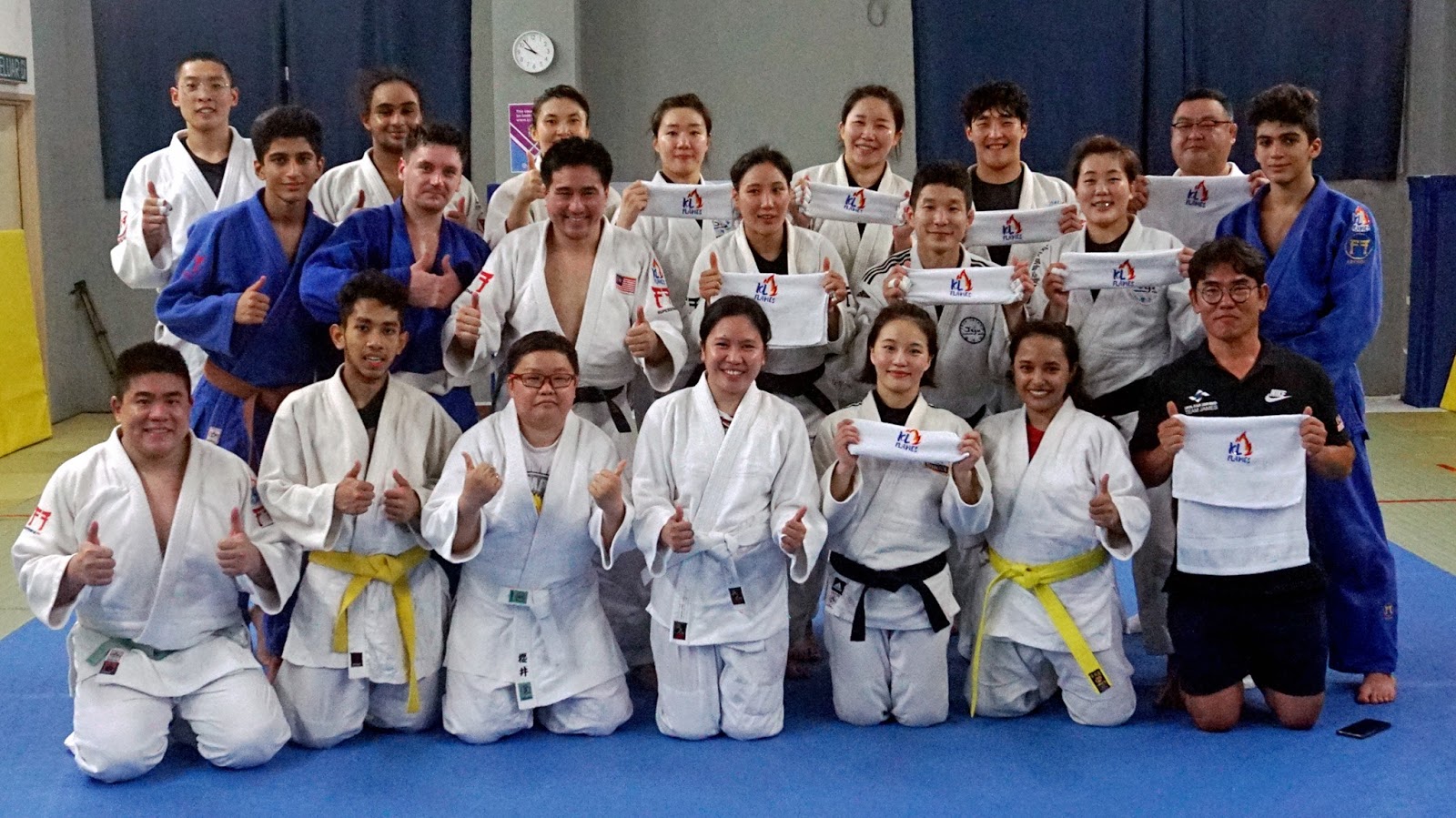
Wednesday, December 11, 2019

Wednesday's Program


Wednesday's Program
1. Gripping Drills:
- Iliadis grip-strength drill
- Korean Shake

2. Controlling Uke (Part 1)
- How to secure a sleeve grip (hikite)
- How to switch from a high-grip attempt to an unexpected attack

3. Controlling Uke (Part 2)
- How to secure a lapel grip (with your hikite)
- How to switch from a high-grip attempt to an unexpected attack

Newaza
Alligator Roll into a yoko-shiho-gatame
- How to roll and bait uke into trapping the leg
- How to extract the leg

Tuesday, December 10, 2019

Purposeful Randori


Randori is an essential component for mastering judo techniques. You do uchikomi to learn how to load up an opponent for a throw, you do nagekomi to get a feel for the execution of the throws, and you do randori to try out the technique against a resisting opponent.

There is a tendency for many players to treat randori as shiai (competition). In some extreme cases, each randori is treated like it's the final of the World Championships. This is not how you are supposed to do randori.

There is no win or lose in randori because it is not shiai. But you definitely lose out if you treat randori as shiai. In shiai you don't want to concede a score so you won't take chances. In contrast, in randori, you're supposed to take chances and try new things. It doesn't matter if you get countered. What's important is that you get to try your technique.

You can use randori to hone a technique that you've already mastered. Maybe you're a little bit rusty and want to sharpen your technique. That's fine. Use randori for that purpose. Or you might want to use randori to try out something completely new. Randori is ideal for that. If you get countered, you learn something about that technique -- you now know what not to do when executing it. And through a process of trial and error, you will figure out the best way to make the technique work.

You can also use randori to figure out a way to thwart your training partner's favorite technique. Let's say your partner always throws you with uchimata, how do you stop it? Or better still, how do you counter it? There are techniques to do that. Try them in randori. Bait your partner into doing uchimata and see if the counter works. If it doesn't, try tweaking your approach to it. You'll have to be willing to be thrown many times before you can figure out a solution to it. Leave your ego at the door of the judo hall and be willing to try, and fail, and get countered. This is how you learn.

Always be purposeful when you do randori. That is, be clear about what it is you are trying to achieve. Have that objective in mind and keep it in mind throughout the randori. Then, you will really benefit from the session.

Monday, December 9, 2019

Play the cards you're dealt with


There's a member of my judo club who is able to train only twice per week because her job schedule doesn't permit her to train more. She works nights and most of our training sessions are at night. So, she is only able to come on her two days off during the week.

I realize this is frustrating for her because she has told me should would like to train four or five times a week if she could.

There is a possibility she could get a morning shift assignment in the future but for now she's stuck with the evening shift. I told her that in the meantime, we just make the most of the two days she has and make every moment count during the training.

There are, for example, some players who attend a session and don't really focus on what's being taught. With such an attitude, even going for training four or fives times a week is a waste of time (waste of their time and waste of the coach's time too). In contrast, someone who just comes twice a week, but is very focused on learning and trying out new skills, will gain so much more.

Yesterday, I chatted with a foreign judo player who happens to be working in Malaysia now. She also has a late shift and has only one day off per week. That's the only day she can come for training, which is not much for someone who wants to get back into competition (she used to be an international competitor but has not trained for nearly a year).

I told her that once a week may not be much but we've got to play the cards we are dealt with. She would rather train more times a week and I too would rather have her train more times per week, of course. But this is not possible given her work schedule. So, what can we do? The answer is we make the most of her one off day per week and make that judo session really count.

Some people like to do things only when the conditions are ideal or "perfect" but in judo, as in life, there's no such thing as perfect conditions. Some situations are better than others but it's never perfect. Whatever cards you're dealt with, you play them the best that you can.

If you've got only two days a week, you train hard during those two days. If you've got only one day a week, make that one day the best session ever. Make the most of your situation, always. If you do that, you'll be much better off than someone who does things just as a matter of course, without any thinking, without any focus, without any intent. Just simply going through the motions. Such a person will gain little to nothing from training.

I always like to say that whatever we learn in judo is applicable to real life and this thing about playing the cards you're dealt, it really applies to real life as well.

Sunday, December 8, 2019

Growing a judo club

While I was in Sandakan for the Borneo Cup, I had conversations with two other judo coaches about how difficult it is to grow a judo club. Anybody who has ever attempted to start and run a judo club will know this to be true.

One of the coaches, from a nearby country, had an interesting membership demographic. Like ours, his club has mainly adults as members. We have kids classes now but we started out as purely an adults class and today, our members are still mainly adults (which is an anomaly here in Malaysia).

He said they don't have many members, which sounds very much like how we were just a few years ago. I told him how important it was to post pictures and videos on social media. It's amazing to me that other clubs don't do it. Social media has brought us most of our members. It's how people get to know about our club.

Yes, editing video takes time. Writing blogs takes time. Even taking pictures and writing interesting captions take quite a bit of time. But we do all that because we realize how important it is. So, I really tried to emphasize this point to the coach.

I told him about how small our membership base was at one time but we slowly grew it with the help of social media. Now, thankfully, we have entered a virtuous cycle whereby when people check out our club, they are pleased to see that there are other adults to train. For beginners, we have many other beginners. For experienced players, we've also got a decent number of players with experience. But to get to where we are today, it took a long time and plenty of social media postings.

Another coach told me the problem he has is that most of his players are juniors who eventually go to college or start working and they leave their hometown to do so. Many go to bigger cities for these things. I told him this is not just a problem he faces. Many clubs face exactly the same problem. That's why I always say that Malaysian judo has an "seniors" problem. We have lots of kids doing judo. By the time they turn to cadets, they start dropping off. By the time they are in their late teens, there's only a few of them left. And by the time they are in university, most of them would have dropped out. Don't even talk about what happens when they graduate!

I told this coach, you've got to recruit some working adults to your club. Adults who take up judo want to do judo. Unlike kids, who are sent to judo by their parents, with adults it's 100% voluntary and you can be sure they are doing judo because they want to, not because somebody told them to. So they tend to stay a bit longer. They are also less likely to suddenly move away to a new city.

Yes, it's easier to recruit kids. Judo is a fairly easy sell to parents because they know judo is a good sport with a strong moral code. So, many parents like the idea of their kids doing judo. It's much, much harder to recruit adults because adults are so busy and caught up with so many "adult" things like work and family obligations. But they are a more stable demographic than kids when it comes to sticking to the sport.

So, in a nutshell, my two pieces of advice to anyone who wants to start a sustainable judo club are:
i) be active on social media
ii) recruit some adults to be the anchor or backbone of your club

Being a good host


Recently, we had some visitors from Jeju come to train at our dojo. It wasn't something we planned or expected. In fact, it literally came out of the blue for su. Apparently the organizers didn't plan their trip properly and as a result, when the team arrived in Malaysia, they had nowhere to train. Somebody gave their facilitator our contact details and we were happy to play host to them.

As with all our guests and visitors, we tried earnestly to provide them with a good experience. They were high-level athletes -- many of them had competed in top-level international competitions -- so we didn't have the same level of athletes to offer them. But we certainly tried our best to call up some coaches and judo friends to try to get more players for them to train with. With such short notice (or rather, no notice at all) it wasn't surprising that nobody could send their top athletes to KL to train with the Jeju team.

So, we had to rely on our own membership to offer them a worthwhile training session. Many of our members showed up, including some who couldn't train but helped take pictures and videos. The Jeju team seemed to appreciate the effort we had put in.

You would think any guest would appreciate it whenever a club takes great pains to ensure a decent crowd. But over the years, we have had a few people who said they wanted to visit our club, only to  cancel on us in the very last moment (after we had called in a lot of players to specially come for training). Some people had postponed their appointments and other activities just to be there for the guest. And what happens? The guest stands us up! It doesn't happen often but it's happened enough times that we are aware this could happen.

They say once bitten, twice shy. Well, that's true to a certain extent. We certainly won't care about people who have stood us up. That's just rude and ungrateful behavior on their part. But the bad behavior of a few rotten apples should not color our judgment of other, new guests who want to visit us. We should not have a cynical view of guests who say they want to visit. Instead, we should assume they are sincere and we should plan for them to have a great, memorable session with us.

It's basically the Golden Rule at play here. If we were to visit another club, we'd certainly want to see many players on the mats. How disappointing it would be if we went all the way to another city or country only to find very few players on the mat. It would mean the host took no effort to ensure that we would have a good session.

If we don't want people doing that to us, we should not do that to others. That's why I always believe if we have guests, we owe it to them to get as many players on the mat as possible. It's the least we could do.

Tuesday, December 3, 2019

It's a small world after all

From the start, we have always been a very diverse judo club, not just in terms of ethnicity but nationalities too. Our club has always been cosmopolitan. Even back in our first dojo in Cheras, we had members from Europe, Africa, the Middle East and different parts of Asia.

Through the years, we have had members come and go but our club continues to remain very diverse with members from all over the world. As we head into the new year, our membership is as multicultural as ever.

A look at our demographics reveals an interesting statistic: We have 20 Malaysian members and 21 foreign nationals!

Among the Malaysians we have representation from all the major ethnic groups: Malay, Chinese, Indian, Sikh as well as players who are natives of Sabah and Sarawak. We are very proud of our muhibbah team. Among the foreign nationals are players from China, France, Great Britain, Indonesia, Ireland, Russia, the Philippines and USA.We are delighted they feel comfortable and welcomed in our club.

As we head into the new year, we hope to get more Malaysians from all backgrounds and more international players joining our club. It's a small world and judo helps to bring all of us even closer together.

Continued growth

Our growth has been good

The end of the year is fast dawning upon us. It's a good time to look back at the growth and evolution of the club.

Although we lost a few members along the way (three dropped out shortly after we moved to our new place), we have gained quite a few new members so the net effect is positive. We have more members now than we did at the start of the year. Hopefully this growth trend will continue next year too.

In the past, when we were still finding our footing, there wasn't a clear demarcation of competitors and recreational players. But today, we have not two but three distinct group of judo players at our club:

a) competitors
b) recreational players
c) kids

Interestingly, the numbers are fairly equal with 15 who can be considered competitors; 15 who can be considered recreational; and 11 kids. That's a healthy mix.

In the coming year, we hope to continue to grow all three segments. It'll be interesting to see which one grows fastest. It's actually very hard to say. Conventional wisdom would say it's the kids segment because traditionally that is where the growth is. Most judo clubs in this country have more kids than adults. This is a clear indication of where the demand is. So, it stands to reason that that segment should be the one to grow the fastest.

But our club is not a typical judo club and our main demographic has always been adults. The fact that we have so many adults training at our club has created a virtuous cycle situation whereby the critical mass of adults that we have is in itself a strong attraction for other adults who want to do judo, to join our club.

No adult judo player likes going to a club and finding only one or two other adults to train with (or in some cases, no adults at all). Well, they won't find that problem at KL Judo Centre. It doesn't matter which session you attend, you will always have enough training partners to have a good workout.

The fact that we have a critical mass of adult competitors and adult recreational players also adds to the virtuous cycle situation. Imagine if a club had mainly recreational players. A competitive type would not like to join such a club. Conversely, imagine is a club consists of only competitors. A recreational player would feel intimidated and not want to join. But at KL Judo, we have a healthy mix of recreational and competitive players so nobody feels left out.

So, will the kids segment experience a boom or will the adults segment experience a growth spurt? Maybe both? Let's see.