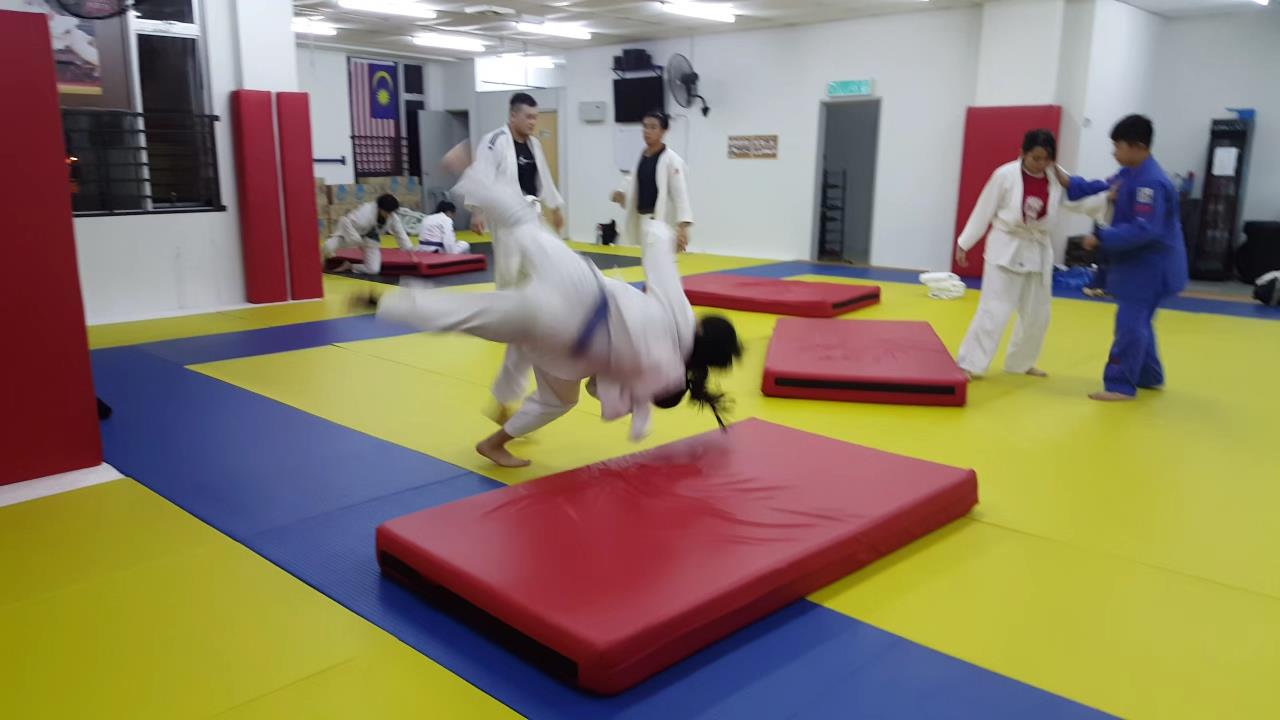
Monday, January 4, 2016

There's more than one way to skin a cat.

As the saying goes, there's more than one way to skin a cat. There are many different judo training systems in the world and there is no "one size fits all" system that works for everybody.

I'm a product of the Western training system. I learned my competition training primarily at the Los Angeles Judo Training Centre and later at Camberley Judo Club and Russelsheim Olympic Training Center (in Germany). I also did some collegiate wrestling while in university.

Naturally, my outlook for training is very Western. The Japanese approach obviously works as they have produced many champions but I believe their system is only suited for their conditions, which is one where you have hundreds of players on the mat and at university level, you have training twice a day and up to 15 randoris a day with a new partner each time.

Under such conditions, the randori alone will provide ample opportunity for the players to develop good gripping skills, throwing skills and mat sense and so on. The one area that the Japanese are not very good at is strategy and they sometimes lose out when they go up against a strong strategic player from the West.

Even world champions have been toppled by excellent strategists. The reason is that no amount of randori will not prepare you for strategic play. Only drills will do that. The Japanese dislike strategic play. They think it's not proper judo. They like to throw for ippon and sometimes, that is enough. But sometimes not. Even the great Toshihiko Koga lost due to strategic grip play by his opponent in the final of the 1996 Atlanta Olympics.

I believe in drills and I believe in randori.

For drills, I break it down to three things:
a) gripping and strategy
b) newaza
c) tachiwaza

For gripping, it's doing drills of different gripping scenarios and how to deal with different types of grip fighters. For strategy, it involves simulating different scenarios to get a leg up on your opponent.

For newaza, I believe a player should identify what core newaza techniques they want to develop and do it over and over again. Firstly without resistance, then with some resistance, then with full resistance. This needs to be done repeatedly over a long period of time until the technique becomes second nature.

For tachiwaza, the same thing. The player must decide what are the two or three techniques he wants to develop and do these over and over again. First without resistance, then with some resistance, finally with almost full resistance.

Once a player is confident he knows the technique well, he has to try it in a randori situation where there are many variables. The opponent is not letting him get a grip, the opponent has an awkward grip, the opponent is resisting and not cooperating, the opponent is moving in a funny way, and so on.

I am a strong believer in randori. The great South Korean Olympic and triple World Champion Jeon Ki-Young says 10 randoris per session, 5 minutes each. I believe in that. Players must build up their stamina to a level where they can sustain 8 to 10 randoris per session.

Every player needs a training partner he can work with. The partner might not be ideal -- not the right height, not the right weight, maybe even not the right gender -- but having a partner is better than having none. Throughout my competition career I always sought out partners. Sometimes they were aikido players who took on judo, sometimes karate, sometimes wrestling, sometimes non-athletes... anybody who was willing to train with me. I provided them with a gi, gave them some basic training and trained with them. It was not ideal but to me, some training is better than none at all.

Friday, December 11, 2015

Judo builds friendships


Impromptu Training (11/12/2015)
We didn't expect to have training today but a request from our guest, Yi Tan, led to an impromptu training that was really quite good!
Posted by KL Judo Club on Friday, December 11, 2015


For those of us who have done judo for most of our lives, it's obvious that judo has many benefits. It's a great sport that keeps you fit and healthy. It also teaches discipline, perseverance and bravery. But one of the things that tends to be overlooked is how judo also builds friendships.

When people with a common love of the sport meet, an instant camaraderie develops. This was certainly the case when I recently met up with Yi Tan, the head coach of The Dojo in Singapore. Although our competition era was roughly around the same time (early- to mid-90s) our paths did not cross until recently. Once we met though, we got along really well. I think that's because we belong to a small breed of judo coaches who happen to have actual international competition experience. As a result our outlook on judo is quite different from those senseis who have never competed at the top level. And unlike some senseis, we don't just strut around on the mat and bark instructions. We actually randori with our players and any guests who come to visit our clubs. That's the difference and that's what makes us kindred spirits.

Yi Tan teaching my junior students some gripping tactics last night.


Like Yi Tan, I'm averse to judo politics. I hate it. Judo politics is practiced by those who can't do judo. So they play politics instead. In contrast, we want the best for our players. So, for 2016, we are planning a whole range of activities so that our players can get more randori and more competition experience. It's very exciting and because we love judo, and abhor judo politics, all our activities will be open to guests who want to join us. Stay tuned for more information.

Judo Chow (second from left) catches up with his old friend Toh Kek Keong (far right), another judo stalwart.


Mr Chow (or Judo Chow, as he is known), an international referee and judo stalwart from Hong Kong, came to visit us last night. He asked if it was ok for him to don his judogi and practice a bit. I said, of course! My junior players had a fun time training with him and I even got a chance to randori with him. We talked a lot about international judo and even discussed a controversial hansoku-make decision at the recent 2015 Tokyo Grand Slam which resulted in Takanori Nagase getting disqualified. We also talked about opportunities for training abroad and possibly setting up friendly matches among clubs in the region.

A good turnout for an impromptu training where some old guards gave tips to a new generation of judo players.


Today's training was unscheduled. But Yi Tan, who was in town for a local competition, asked if he could drop by with a few of his young players. So we called a few of our junior players to join in as well. As a bonus, Judo Chow dropped by and joined in the training. The young players did some rolling about and the slightly older ones got some tips from the old guards. We ended the session with some good, old-fashioned randori. Everybody broke a sweat and had a good time. This is what judo is all about.

There's no better way to end a training session than to have a nice meal at a Chinese restaurant.


After the training, we brought our guests to a nearby Chinese restaurant where we had an excellent meal courtesy of Mr Lim, the team manager and KL Judo co-founder. We started the club in May and it's been an interesting ride to say the least. We've learned a lot along the way and we are delighted with how things have turned out so far. Our club is not exactly filled to the brim with players but our policy has always been "quality over quantity". Since May, we've had players come and go, and we are very happy with the players who have chosen to stick with us. They all have a very good attitude and are the kinds of players we want.

We have an open door policy and welcome all guests. Even if players don't want to be members they can pay a mat fee and train on an ad hoc basis. Actually, we've had a few players from other clubs tell us they want to train with us because they've heard good things about our competition-styled training. But they don't dare to come because their insecure senseis forbid them from training elsewhere. A few actually came to visit but we discreetly did not post their pictures in our blog or Facebook Page because we didn't want them to get into trouble. Isn't it a sad state of judo affairs when players have to train in secret?

Our last activity of the year will be our first Winter Training where we will host players from The Dojo (Singapore).


Time flies and it is nearly year-end already. We thought the Penang team competition that was recently over would be the last major activity for the year but a recent visit to Singapore yielded an interesting proposition. Yi Tan and his team made us feel really welcome and I invited him and his team to visit us for some training in KL. We toyed around with some potential dates for the end-of-the-year joint training camp and he finally suggested X'mas weekend. I wasn't sure if many of my players would be around but as it turns out, only two of them would be out of the country. The rest would be around and could train. So, we decided to make it a Winter Training camp. Well, it won't exactly be cold but it's still X'mas training so we shall call it Winter Training. I have some exciting programs for them and we will probably have a few guests from out of town as well.

We'll be posting us some nice videos and pictures from that training. So watch, this space!

KL Judo Club

66-3, Wisma Alam Damai,
Jalan Alam Damai, Cheras,
56000 Kuala Lumpur
Tel: +6016 6262004 or +6012 3893148

Monday, November 30, 2015

X'mas Judo Training

Ho! Ho! Ho! Who is crazy enough to hold judo training camps over the X'mas holidays? KL Judo players of course!

We will be holding special X'mas training sessions on Dec 25, 26 & 27 evenings, together with visiting judokas from Singapore. If you happen to be in KL during those evenings, come join us. Besides our regular players, there will be about 20 Singaporean players (roughly 10 boys, 10 girls).

Participation is FREE (it's X'mas after all). Contact us if you wish to join!


This is our address:
KL Judo Club
66-3, Wisma Alam Damai,
Jalan Alam Damai, Cheras,
56000 Kuala Lumpur
Tel: +6016 6262004 or +6012 3893148

(We are located above the cafe: Love Me Seven Days)

Monday, October 19, 2015

Ashiwaza Masterclass


Ashiwaza Training
The players had an ashi-barai and kosoto-gari masterclass on Monday night. Here are clips of them training.
Posted by KL Judo Club on Monday, October 19, 2015

On Monday night,  a few players underwent an Ashiwaza Masterclass. Well, specifically the techniques of De-Ashi-Barai and its similar (but conceptually different) cousin, Kosoto-Gari.

There are many other techniques in Ashiwaza and I had intended to cover many more last night but time did not permit. When you zero in on a technique and really break it down and have the players do the necessary drills to learn the technique, it actually takes up a lot of time. And as the players learned (to their surprise and to mine) they were actually very tired. I guess when you really focus on something, it's tiring.

De-Ashi-Barai is a foot-sweep and as such it classified as a technique that requires finesse. A technique that requires finesse cannot be forced. Timing and a good feel for the technique are crucial. There are some techniques where you can force it through and catch your opponent even if they see the technique coming and are trying to block it. De-Ashi-Bari is not one of them.

So, how do you train a "finesse" technique?

Like all techniques, you have to do drills. But precisely because it calls for finesse, the drills you'd do for something like this would be different from the drills for say, Kouchi-Makikomi, which is more of a "force" technique than a "finesse" technique.

What I had the players do was a semi-circular movement drill that required the partners to move in concert (with tori leading and uke following) and then having tori initiate a De-Ashi-Barai just at the right moment when uke is taking a step forward.

This is actually a common movement for demonstrating De-Ashi-Barai in Japan. And I believe it's a good one for learning this technique. My approach to training is generally quite unorthodox and not very Japanese but I do like some of their approaches. Their emphasis on randori, for example, is something I really believe in. Their approach to teaching timing for ashiwaza is another that is worth emulating.

I'm not a big fan of uchikomi in general. So much repetition of a movement done in an unrealistic situation doesn't help a player learn how to throw. I much prefer nagekomi on a crash pad for teaching a player how to execute a throw properly (followed up with trying out the throw in randori). But for techniques that require finesse, such repetitive semi-circular movements (not sure if you'd classify it as uchikomi or not) is necessary.

Finesse techniques like De-Ashi-Barai are very dependent on the sense of movement and timing. So doing those movements is necessary. As it is, the players had difficulty catching uke's advancing foot at just the right time, even with a cooperative uke who was moving in sync with tori. So, they must practice this repeatedly until they can get a sense of timing for it.

The natural question someone might ask about the value of the drill of having people move in concert and then having tori initiate the foot-sweep is whether it teaches them to apply the technique in a real randori or competition situation.

If all they did was this initial drill, then they will never learn to apply it in a more realistic, non-cooperative scenario, of course. But it is necessary for them to have an understanding of timing for a finesse technique like this.

After that, they can try to do this in a free moving (but still cooperative) drill. And finally of course the real test is to begin to use it in randori. If they've done lots of drills already and have a sense of the timing required for such techniques, then during certain moments in randori, they will suddenly recognize the right opportunity and moment to put in that foot-sweep.

So, that is how the Masterclass went last night. They practiced this technique for well over an hour. After that they did a bit of Kosoto-Gari but we will go into that in more detail in the next Masterclass session.

In time, I plan to go through the entire syllabus of common competition techniques, of which there is quite a wide range. So the Masterclass will go on for a long time.

Saturday, September 19, 2015

Juji-Gatame Masterclass Part 4: Ecky-Gatame

What do you do when despite all your efforts, you are not able to straighten uke's arm? There is a unique solution and it has no Japanese name because it's not a Japanese technique. It's informally called the Ecky-Gatame, named after its creator, Neil Eckersley of Great Britain, who first used it in the early 80s and won many competitions with it, including an Olympic bronze medal.

The technique calls for you to transition from a juji-gatame position into a kind of hold down position that is not very stable. It doesn't take a whole lot for uke to turn away from the hold and try to spin onto his front. However, in order to do so, he needs to let go of his arms. The moment he does that, tori snaps on an armlock, preventing him from turning and forcing him to submit.

Uke is basically caught between the devil and the deep blue sea. If he doesn't try to turn out of the hold-down, he will lose by ippon in 20 seconds. If he tries to spin out, he will leave his arm exposed and ready to be armlocked. Either way, he is faced with the prospect of losing.

Here's a video example of how it's done:

Ecky-Gatame
This is a unique hold down that can be switched into a juji-gatame in a moment's notice.
Posted by KL Judo Club on Saturday, September 19, 2015


And here are the pics showing the detailed breakdown of the technique.

This technique is a good solution when you can't straighten uke's arm.

Start by grabbing your own left lapel with your right hand.

Reach over and grab his right trousers leg with your right hand.

Pull yourself up on top of him. Not completely on top but a little bit by the side.

To escape uke tries to turn away from you. He has to release his arms in order to execute the turn. This is when you snap on an armlock.

Make sure you place your right leg over his face to prevent him from escaping.

As seen from the other side. Am already in the Ecky-Gatame position.

It doesn't feel like a very stable hold-down and uke is tempted to roll out of it by releasing his arms and starting to turn towards his right.

This is the moment you've been waiting for. You have to immediately snap on an armlock before he escapes.

Before he knows it, he has fallen into a classic juji-gatame position, with his arm straightened.

Friday, September 18, 2015

Juji-Gatame Masterclass Part 3: The Arm Lever

In Part 1: The Iastkevich Roll and Part II: The Adams Roll, we showed you how to roll your opponent into the Juji-Gatame position. Next, how to straighten his arm.

If you just tug and tug without any leverge, you probably won't be able to straighten his arm. There's a very simple arm lever that you can use to straighten his arm. Here's the video demonstration of it.


Arm Lever
An effective and efficient way to straighten the arm from a juji-gatame position.
Posted by KL Judo Club on Friday, September 18, 2015


And here are the pictures that break it down step-by-step.

Start by shooting your right forearm underneath uke's left forearm. Uke will be holding on for dear life as he doesn't want his arm to be straightened. Your forearm should be near his wrist.

Place your left forearm on the side of his left forearm, on the outside.

Clasp your hands together. This will position your forearms to create a shearing action that will provide leverage to straighten his arm.

Instead of pulling straight back, do a slightly rotating action with your arms, in a clockwise direction. You pull with your right arm and push with your left.

Uke will not be able to resist and his arm will go straight.


Wednesday, September 16, 2015

Juji-Gatame Masterclass Part 2: Adams Roll

The Neil Adams Roll is similar to the Iastkevich Roll except that it involves a Figure-4 grip on your opponent's left hand instead of a simple catch with a grip on your own lapel. The Adams Roll is more versatile than the Iastkevich roll in that it allows you to roll your opponent from the back (legs) as well as the front (head). With the Iastkevich Roll, you can only roll him from the back (legs).

This is the clip of the whole movement.

Adams Roll
This is the accompanying video clip for the blog posting on the Neil Adams Roll into juji-gatame.
Posted by KL Judo Club on Wednesday, September 16, 2015


And the following still pics show the breakdown of the movement in detail.

In the Adams Roll, "the catch" is done from under your opponent's left armpit and securing his left arm with your left hand.

A close-up look at how you achieve the crucial Figure-4 grip on your opponent. Initially, it is your left hand that has a grip on uke's left forearm.

You make the switch and now your right hand is holding onto uke's left forearm.

The move complete when your left hand grips your own right wrist. This is the Figure-4 you're looking for.

Let's zoom back out. This is what you look like at the start of the roll, with the Figure-4 secured.

To initiate the roll, I post on my forehead.

From there, I could have rolled to the front or the back. My default first option is usually to attack the back (legs).

This is what it looks like from another perspective. Notice I still have the Figure-4 secured.

It is vitally important to maintain the Figure-4. Once you lose it, you will not be able to do the roll.

To rotate him over, I exert pressure on his left arm by using the Figure-4 as a lever.

To ease the pressure on his arm, uke has to roll over.

Although the Figure-4 lever is doing most of the work, my left leg comes into play too, helping to guide uke over.

Once he is flat on his back its important to bring my right leg over his head to prevent him from sitting up.

The beauty of the Adams Roll is its versatility. Let's say I find it difficult to roll uke over from the back. I have the option to roll him over from the front because of the Figure-4 grip. The Iastkevich roll, which involves a simple catch of my own lapel doesn't allow for this.

To make the switch, I go back to my original position where I post on my forehead.

And I switch directions. Now, I'm attacking the front (his head). Notice how I place my right leg underneath his head. This will give me the leverage I need to execute the roll.

Using my right leg, I rotate him over from the front rather than the back. In this position, the Figure-4 acts to secure him from escaping but the bulk of the rotation work is done by the right leg.

As he falls onto his back, I place my right leg over his head to prevent him from sitting up.

Lastly, I sit up to position myself to begin to straighten his arm (but that's a topic for another posting).