Monday, November 30, 2015

X'mas Judo Training

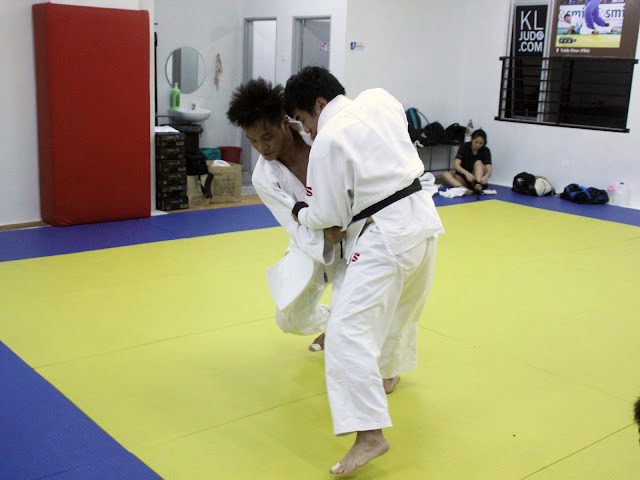
Ho! Ho! Ho! Who is crazy enough to hold judo training camps over the X'mas holidays? KL Judo players of course!

We will be holding special X'mas training sessions on Dec 25, 26 & 27 evenings, together with visiting judokas from Singapore. If you happen to be in KL during those evenings, come join us. Besides our regular players, there will be about 20 Singaporean players (roughly 10 boys, 10 girls).

Participation is FREE (it's X'mas after all). Contact us if you wish to join!


This is our address:
KL Judo Club
66-3, Wisma Alam Damai,
Jalan Alam Damai, Cheras,
56000 Kuala Lumpur
Tel: +6016 6262004 or +6012 3893148

(We are located above the cafe: Love Me Seven Days)

Monday, October 19, 2015

Ashiwaza Masterclass


Ashiwaza Training
The players had an ashi-barai and kosoto-gari masterclass on Monday night. Here are clips of them training.
Posted by KL Judo Club on Monday, October 19, 2015

On Monday night,  a few players underwent an Ashiwaza Masterclass. Well, specifically the techniques of De-Ashi-Barai and its similar (but conceptually different) cousin, Kosoto-Gari.

There are many other techniques in Ashiwaza and I had intended to cover many more last night but time did not permit. When you zero in on a technique and really break it down and have the players do the necessary drills to learn the technique, it actually takes up a lot of time. And as the players learned (to their surprise and to mine) they were actually very tired. I guess when you really focus on something, it's tiring.

De-Ashi-Barai is a foot-sweep and as such it classified as a technique that requires finesse. A technique that requires finesse cannot be forced. Timing and a good feel for the technique are crucial. There are some techniques where you can force it through and catch your opponent even if they see the technique coming and are trying to block it. De-Ashi-Bari is not one of them.

So, how do you train a "finesse" technique?

Like all techniques, you have to do drills. But precisely because it calls for finesse, the drills you'd do for something like this would be different from the drills for say, Kouchi-Makikomi, which is more of a "force" technique than a "finesse" technique.

What I had the players do was a semi-circular movement drill that required the partners to move in concert (with tori leading and uke following) and then having tori initiate a De-Ashi-Barai just at the right moment when uke is taking a step forward.

This is actually a common movement for demonstrating De-Ashi-Barai in Japan. And I believe it's a good one for learning this technique. My approach to training is generally quite unorthodox and not very Japanese but I do like some of their approaches. Their emphasis on randori, for example, is something I really believe in. Their approach to teaching timing for ashiwaza is another that is worth emulating.

I'm not a big fan of uchikomi in general. So much repetition of a movement done in an unrealistic situation doesn't help a player learn how to throw. I much prefer nagekomi on a crash pad for teaching a player how to execute a throw properly (followed up with trying out the throw in randori). But for techniques that require finesse, such repetitive semi-circular movements (not sure if you'd classify it as uchikomi or not) is necessary.

Finesse techniques like De-Ashi-Barai are very dependent on the sense of movement and timing. So doing those movements is necessary. As it is, the players had difficulty catching uke's advancing foot at just the right time, even with a cooperative uke who was moving in sync with tori. So, they must practice this repeatedly until they can get a sense of timing for it.

The natural question someone might ask about the value of the drill of having people move in concert and then having tori initiate the foot-sweep is whether it teaches them to apply the technique in a real randori or competition situation.

If all they did was this initial drill, then they will never learn to apply it in a more realistic, non-cooperative scenario, of course. But it is necessary for them to have an understanding of timing for a finesse technique like this.

After that, they can try to do this in a free moving (but still cooperative) drill. And finally of course the real test is to begin to use it in randori. If they've done lots of drills already and have a sense of the timing required for such techniques, then during certain moments in randori, they will suddenly recognize the right opportunity and moment to put in that foot-sweep.

So, that is how the Masterclass went last night. They practiced this technique for well over an hour. After that they did a bit of Kosoto-Gari but we will go into that in more detail in the next Masterclass session.

In time, I plan to go through the entire syllabus of common competition techniques, of which there is quite a wide range. So the Masterclass will go on for a long time.

Saturday, September 19, 2015

Juji-Gatame Masterclass Part 4: Ecky-Gatame

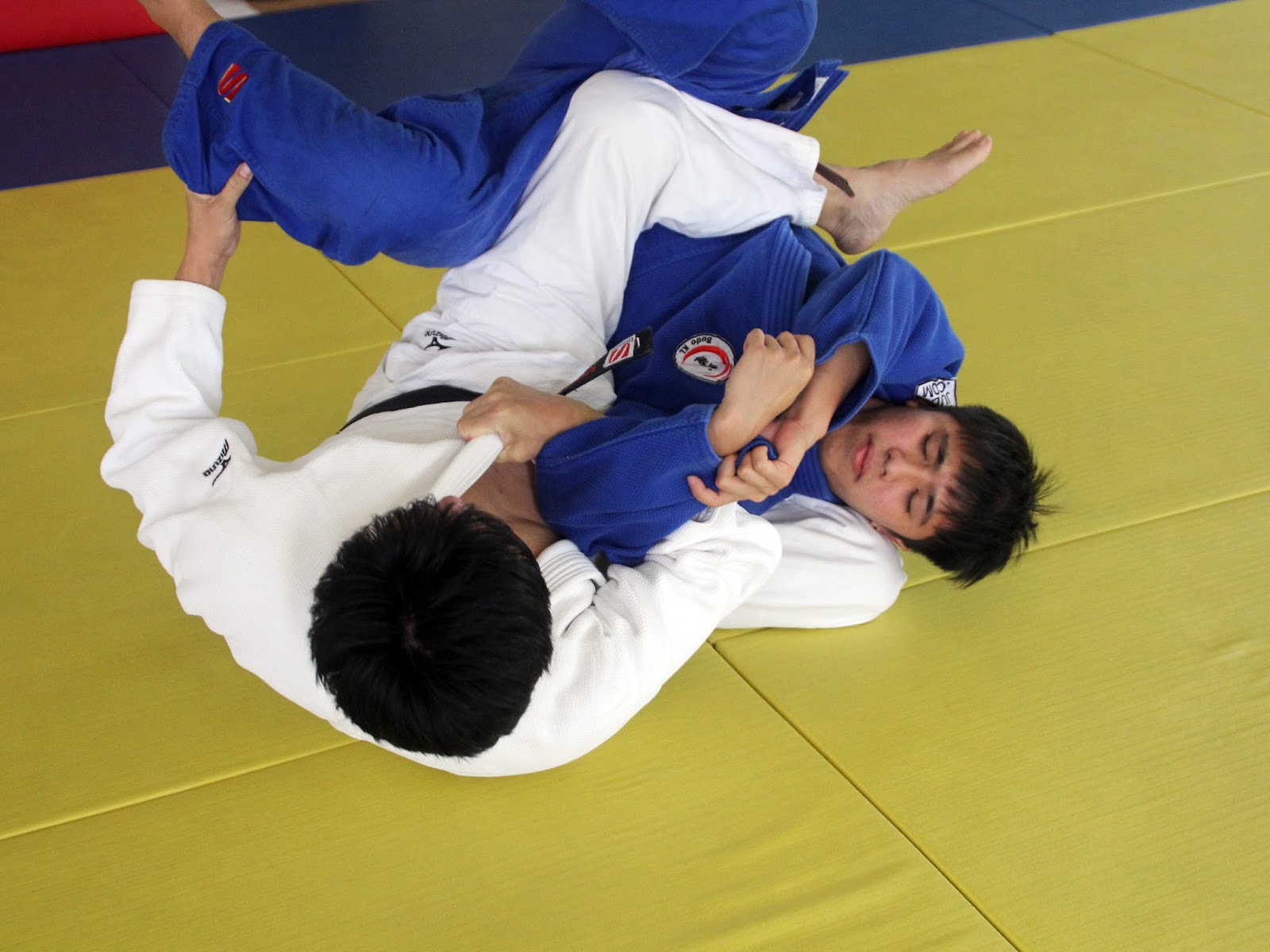
What do you do when despite all your efforts, you are not able to straighten uke's arm? There is a unique solution and it has no Japanese name because it's not a Japanese technique. It's informally called the Ecky-Gatame, named after its creator, Neil Eckersley of Great Britain, who first used it in the early 80s and won many competitions with it, including an Olympic bronze medal.

The technique calls for you to transition from a juji-gatame position into a kind of hold down position that is not very stable. It doesn't take a whole lot for uke to turn away from the hold and try to spin onto his front. However, in order to do so, he needs to let go of his arms. The moment he does that, tori snaps on an armlock, preventing him from turning and forcing him to submit.

Uke is basically caught between the devil and the deep blue sea. If he doesn't try to turn out of the hold-down, he will lose by ippon in 20 seconds. If he tries to spin out, he will leave his arm exposed and ready to be armlocked. Either way, he is faced with the prospect of losing.

Here's a video example of how it's done:

Ecky-Gatame
This is a unique hold down that can be switched into a juji-gatame in a moment's notice.
Posted by KL Judo Club on Saturday, September 19, 2015


And here are the pics showing the detailed breakdown of the technique.

This technique is a good solution when you can't straighten uke's arm.

Start by grabbing your own left lapel with your right hand.

Reach over and grab his right trousers leg with your right hand.

Pull yourself up on top of him. Not completely on top but a little bit by the side.

To escape uke tries to turn away from you. He has to release his arms in order to execute the turn. This is when you snap on an armlock.

Make sure you place your right leg over his face to prevent him from escaping.

As seen from the other side. Am already in the Ecky-Gatame position.

It doesn't feel like a very stable hold-down and uke is tempted to roll out of it by releasing his arms and starting to turn towards his right.

This is the moment you've been waiting for. You have to immediately snap on an armlock before he escapes.

Before he knows it, he has fallen into a classic juji-gatame position, with his arm straightened.

Friday, September 18, 2015

Juji-Gatame Masterclass Part 3: The Arm Lever

In Part 1: The Iastkevich Roll and Part II: The Adams Roll, we showed you how to roll your opponent into the Juji-Gatame position. Next, how to straighten his arm.

If you just tug and tug without any leverge, you probably won't be able to straighten his arm. There's a very simple arm lever that you can use to straighten his arm. Here's the video demonstration of it.


Arm Lever
An effective and efficient way to straighten the arm from a juji-gatame position.
Posted by KL Judo Club on Friday, September 18, 2015


And here are the pictures that break it down step-by-step.

Start by shooting your right forearm underneath uke's left forearm. Uke will be holding on for dear life as he doesn't want his arm to be straightened. Your forearm should be near his wrist.

Place your left forearm on the side of his left forearm, on the outside.

Clasp your hands together. This will position your forearms to create a shearing action that will provide leverage to straighten his arm.

Instead of pulling straight back, do a slightly rotating action with your arms, in a clockwise direction. You pull with your right arm and push with your left.

Uke will not be able to resist and his arm will go straight.


Wednesday, September 16, 2015

Juji-Gatame Masterclass Part 2: Adams Roll

The Neil Adams Roll is similar to the Iastkevich Roll except that it involves a Figure-4 grip on your opponent's left hand instead of a simple catch with a grip on your own lapel. The Adams Roll is more versatile than the Iastkevich roll in that it allows you to roll your opponent from the back (legs) as well as the front (head). With the Iastkevich Roll, you can only roll him from the back (legs).

This is the clip of the whole movement.

Adams Roll
This is the accompanying video clip for the blog posting on the Neil Adams Roll into juji-gatame.
Posted by KL Judo Club on Wednesday, September 16, 2015


And the following still pics show the breakdown of the movement in detail.

In the Adams Roll, "the catch" is done from under your opponent's left armpit and securing his left arm with your left hand.

A close-up look at how you achieve the crucial Figure-4 grip on your opponent. Initially, it is your left hand that has a grip on uke's left forearm.

You make the switch and now your right hand is holding onto uke's left forearm.

The move complete when your left hand grips your own right wrist. This is the Figure-4 you're looking for.

Let's zoom back out. This is what you look like at the start of the roll, with the Figure-4 secured.

To initiate the roll, I post on my forehead.

From there, I could have rolled to the front or the back. My default first option is usually to attack the back (legs).

This is what it looks like from another perspective. Notice I still have the Figure-4 secured.

It is vitally important to maintain the Figure-4. Once you lose it, you will not be able to do the roll.

To rotate him over, I exert pressure on his left arm by using the Figure-4 as a lever.

To ease the pressure on his arm, uke has to roll over.

Although the Figure-4 lever is doing most of the work, my left leg comes into play too, helping to guide uke over.

Once he is flat on his back its important to bring my right leg over his head to prevent him from sitting up.

The beauty of the Adams Roll is its versatility. Let's say I find it difficult to roll uke over from the back. I have the option to roll him over from the front because of the Figure-4 grip. The Iastkevich roll, which involves a simple catch of my own lapel doesn't allow for this.

To make the switch, I go back to my original position where I post on my forehead.

And I switch directions. Now, I'm attacking the front (his head). Notice how I place my right leg underneath his head. This will give me the leverage I need to execute the roll.

Using my right leg, I rotate him over from the front rather than the back. In this position, the Figure-4 acts to secure him from escaping but the bulk of the rotation work is done by the right leg.

As he falls onto his back, I place my right leg over his head to prevent him from sitting up.

Lastly, I sit up to position myself to begin to straighten his arm (but that's a topic for another posting).

Juji-Gatame Masterclass Part 1: Iastkevich Roll

When people think of the juji-gatame roll, the move that usually comes to mind is the version popularized by Alexander Iastkevich (RUS), who was a master of the armlock. In fact, it was by watching Iastkevich that Neil Adams (GBR) came to become a juji-gatame specialist himself, basing his own unique version (which we will cover shortly) on the Iastkevich roll.

This is the clip of the whole movement:

Iastkevich Roll
This is the accompanying video clip for the blog posting on the Alexander Iastkevich Roll into juji-gatame.
Posted by KL Judo Club on Wednesday, September 16, 2015

And these pics show the breakdown of the movement in detail.

Whenever you attempt to do juji-gatame, it is important you sit atop your opponent's back and dig your legs securely inside his leg in order to control him adequately for you to initiate the roll. Otherwise, he will just escape.

I do "the catch" by looping my right arm over his left shoulder and securing his left arm.

Notice how I grab my own left lapel to secure "the catch" on his left arm.

With my free (left) hand, I reach for his left trouser leg.

Next, I tug on that trouser leg, pulling him above and over my own body.

As he gets rotated over, it is important that I maintain my grip on his left arm by holding on tightly to my own left lapel. If I lose that grip, he will be able to escape the roll.

I continue with the rotation, guiding him onto his back.

Once he is on his back, it is important to bring my right leg over his head in order to prevent him from sitting up and escaping.

Here is the roll seen from another angle, to give you a fuller perspective.

Remember, when you pull on his trouser leg, the rotation is meant to be over your own body.

Keep pulling on the leg as you guide him over your own body and lay him flat on his back.

It's important to bring your right leg over his head or else he will be able to sit up and get away.

Now, you are in a good position to do the next move, which is to straighten his arm.


Wednesday, August 12, 2015

Wednesday 12/8/2015 (Kouchi Masterclass)

On Wednesday, I conducted the first ever Technique Masterclass where I devoted the entire session to covering every aspect of just one technique. The first technique to be given this treatment was Kouchi-Gari. I taught different types of kouchi (for different gripping situations), common combinations and typical counters. You could say it was the A to Z of Kouchi. To bolster their learning, I got the players to do lots of drills including static uchikomi, moving uchikomi, moving nagekomi and lastly, a Kouchi-only randori.

Kenka-Yotsu

It is very important for tori to be very cognizant of the stance their uke prefers. If uke is left-handed and tori is right handed, they end up in a typical Kenka-Yotsu situation as depicted above (left vs right). In such a situation, certain versions of Kouchi can be applied.

Ai-Yotsu

However, if uke is a strong right hander and insists on adopting a right hand stance against an equally strong right-handed tori, you will end up with a classic Ai-Yotsu situation (right vs right). In such a case, a different type of Kouchi has to be used. (What works in a Kenka-Yotsu situation might not necessarily work in an Ai-Yotsu situation).

Skipping Kouchi (Kenka-Yotsu); Kouchi-Gake (Ai-Yotsu), Kouchi-Makikomi (Kenka-Yotsu)

It's important to know what kind of Kouchi works best for what kind of stance situation. I highlighted three effective variations (2 for Kenka-Yotsu and 1 for Ai-Yotsu).


The first version I demonstrated is for a Left vs Right situation. The technique is called Skipping Kouchi-Gari. It's called Skipping Kouchi because to effect the technique, you have to do a little skip towards your opponent's far leg. British World Champion Neil Adams used this to great effect. Among today's top competitors, the best proponent of the Skipping Kouchi is Japan's World Champion Naohisa Takato.

Here, we have a classic Kenka-Yotsu situation. Uke's far leg too far away for me to reach without making a skipping movement.

So, I take a step with my right leg, so that my right foot lands somewhere in front and in between Uke's two feet.

I follow that up by advancing my left leg. Notice how my right leg is ready to spring into action.

With Uke's right leg now within reach, I move in with a reaping action to catch Uke's right heel with my right foot.

One common mistake players make is to reap too high up. Here, Tori places his foot too high up, behind Uke's calf.

Ideally, the side of Tori's foot should be place on the heel of Uke's foot. This allows for an effective reaping action.

To get the players to understand the technique, I had them do moving uchikomi and nagekomi. Static uchikomi is not enough.

Here, you can see Suan Wah catching his partner's right foot, cupping it nicely with the side of his right foot and reaping it away.

With his right foot reaped away, Uke goes down, landing on his butt.

Suan Wah continues with the pushing action, causing his partner to fall on his back (which would have gotten a score).

The next version I taught was Kouchi-Gake, which is a rather unusual technique. It is seldom seen because Ai-Yotsu situations are a lot rarer than Kenka-Yotsu situations and so you don't have a lot of players doing this. Japan's double World Champion Hirotaka Okada famously used this technique to win his second world title. Among today's top players, France's David Larose is known to use this technique frequently.


In an extreme Right vs Right situation, there's not much room for skipping in with momentum. It's hard to execute a classic kouchi-gari.

Instead, this unusual looking Kouchi-Gake is used. It looks awkward but it's very effective when done right.


The awkwardness of the movement required me to literally help Tori get his leg in the right position.

Here, you can see the positioning from the other side.

Here, you can see Tori starting the technique by hooking in with his right leg. This is not a reaping action but a hooking action.

Once hooked in, Tori has to effect an almost Uchimata-type of movement.

The strong right arm action by Tori complements his Uchimata-like movement to cause Uke to bend over and lose balance.

If you just look at this single frame, you'd be forgiven for thinking Tori has just done an Uchimata. Neil Adams has referred to this technique as "Reverse Uchimata" in some of his video highlights commentaries because of how similar it is to Uchimata.

Earlier I had shown how a Skipping Kouchi can be used in a Kenka-Yotsu situation for Tori to attack Uke's right leg. Now, I show another Kouchi variation that can also be used to good effect in a Kenka-Yotsu situation. But this time, it is to attack Uke's left leg (not right leg).

Here, you see me in a classic Kenka-Yotsu situation. I could attack the right leg with Skipping Kouchi.

But as an alternative, I can also attack Uke's left leg with a wrapping "Makikomi" action that is more of a sacrifice throw than a Gari (reaping) or Gake (hooking) action. It requires me to thrown all my weight into attack and cling onto Uke's left leg.

Next up, Combinations. It's often quite difficult to throw your opponent with a direct attack. That's where combinations come in handy. You attack them with one technique and as they try to escape that one, you attack them immediately with a follow-up technique.


The first combination I showed them starts off as Kouchi but ends up with Deashi-Barai. This is quite a classic move that requires quick movement and good timing for it to work. You must practice this over and over again to get the timing right.


I start off by doing a typical Kouchi-Gari on Uke.

I initiate a reaping action to lift Uke's right foot slightly off the mat and towards me.

As Uke withdraws his right foot to place it back onto the mat, I quickly sweep away that foot before it is placed back on the mat.

The other combination I showed them was a movement that starts with Uchimata and ends with Kouchi-Gari. Also quite a classic movement but does not require as much timing and finesse as the Kouchi-Gari into Deashi-Barai combination I described earlier.


Tori enters into a typical Uchimata situation.

He lifts up Uke's left leg, causing all of Uke's weight to be balanced on his right leg.

Instead of continuing to lift Uke's left leg, Tori suddenly switches the attack into a Kouchi-Gari on Uke's right leg.

Any teaching of Kouchi would not be complete without Counters. The first one, Kouchi-Gaeshi, is useful for Skipping Kouchi-Gari type of attacks. It requires a good sense of timing though, so it's not commonly seen
.


Here, Uke attacks Tori with a standard Kouchi-Gari against Tori's left leg.

Tori anticipates this and immediately withdraws his left leg to avoid it being reaped.

Now, the technique becomes a hand movement (Te-Waza) with Tori wheeling Uke over just like turning a steering wheel.

When done correctly, it lands Uke flat on his back. This technique is not commonly seen but it does happen in international competitions.

Next, a counter against Kouchi-Makikomi.

Kouchi-Makikomi usually involves a slight Seoi-Nage feint, to get Uke to pull backwards.

One of the most common mistakes players make is to enter into this technique from too high a position.

Entering too high makes you susceptible to counters such as Ura-Nage and Tani-Otoshi.

One simple and effective way to avoid counters is to enter low. That way even if your attack fails, you are already on the ground and your opponent will have a difficult time countering you.

Kouchi-Gake is not commonly used and so the counter to it is even rarer. But a counter does exist. One of the most dramatic examples of this happened in a match between Japan's Takato and South Korea's Jang.

Takato and Jang in a classic Left vs Left (Kenka-Yotsu) situation.

Jang, who had thrown Takato with Kouchi-Gake before enters into the attack but Takato anticipates this and begins the counter-attack.

The counter is a Te-Waza. It's all hands, no legs involved at all. It's purely a hand throw. Very rare.

But it works like a charm and lands Jang flat on his back.