Wednesday night was a rainy night. And whenever it rains in KL, there's major traffic jams everywhere. I feared the worse and prepared for a lacklustre turnout. I figured if perhaps five or six players showed up, we could still have a good practice. Turns out, Wednesday saw our biggest turnout ever with nearly 20 players on the mat.
 |
| I arrived a little late and to my surprise, there were already quite a few players on the mat already. |
 |
| Chew managed to make it too, albeit a little late. It's good to have an experienced competitor and a capable technician like Chew on the mat. |
 |
| I decided to get the players to do some High Intensity Interval Trainings. These involved three sets of 12 exercises done over seven minutes. It's a lot tiring than it may seem. |
 |
| They might look like they are relaxing but actually this is quite a challenging exercise that causes "sourness" in the legs. A lot of people were groaning during this module. |
 |
| After that tiring warm up, the players get a chance to sit down and watch some judo videos. We use videos extensively at KL Judo. I showed them some clips of illegal waki-gatame. Sometimes the referees (rightly) give hansoku-make for it. Other times they actually let it go (which is a travesty). |
 |
| I then show them a famous standing armlock popularized by British World Champion Neil Adams. This is perfectly legal as long as you don't try to throw your opponent while doing it. |
 |
| Next, I show them what a Figure-4 grip looks like. This is essential for the juji-gatame roll made famous by Neil Adams. I showed them a clip of him winning his 1981 World title with this technique. |
 |
| It's a very versatile technique. When you are in this position, you can turn your partner from the front (head) or the back (legs). A lot of it depends on your partner's reaction. |
 |
| Whichever turn you make you should maintain the Figure-4 grip throughout. The key really is the grip. |
 |
| We had a visitor today, Ayu, who was a former National Champion and ex-SEA Games competitor at -52kg. We've been having lots of visitors since we opened and we welcome everybody. |
 |
| I guide Ayu through the process of securing the Figure-4 and doing the Neil Adams juji-gatame roll. She was familiar with juji-gatame but not this specific roll. As an experienced judoka with a good feel for judo, she managed to pick it up fast. |
 |
| And here I am guiding her through the mechanics of the arm lever that Neil Adams uses to straighten uke's arm. It's not so much about strength but about positioning your arms correctly. |
 |
| Qaini works on getting her arms into position to execute the arm lever so she can straighten her partner's left arm. |
 |
| Aishah didn't like newaza when I first met her but in the short time since she started training here, she's develop an interest in newaza. We emphasize newaza a lot here and always start our training sessions with newaza. |
 |
| We had a big group on Wednesday. Luckily, Chew was on hand to help guide some of the players. |
 |
| Here, Chee Wah, a high school boy from Sri Bintang Utara (a government school that actually has a judo program) tries to execute the arm lever under Chew's tutelage. |
 |
| Zaki, a Saudi Arabian student from UCSI University, is determined to straighten his partner's left arm. |
 |
| Next, I show them a special move called Ecky-Gatame, which is named after British Olympic bronze medalist Neil Eckersley. It's an osaekomi that tempts your partner to turn out towards his right. When he does that, you can lean back and straighten his arm. It's quite an ingenious move and one of the few judo moves invented in Europe that the IJF recognizes. |
 |
| Qaini doing the Ecky-Gatame. Notice how her buttocks are just slightly off the mat. Once that happens, osaekomi is called. If the buttocks are on the mat, it's no osaekomi. |
 |
| Chew guides Zaki with this technique, which is very popular throughout Europe. It's very effective. |
 |
| Nazrul, a former Sekolah Bintang Utara schoolboy, now in college, tries his hand at the Ecky-Gatame. |
 |
| And so does Cherylynn, a Sekolah Bintang Utara schoolgirl, who contacted us and said she wanted to learn competition techniques. |
 |
| After newaza of course is tachi-waza. Wai Kit, who is still injured, helps out with the junior players. |
 |
| I like to have the students do a line-up as it gives each tori a chance to throw many, many players. |
 |
| The technique that I had them work on last night was drop seoi-nage, probably the most popular competition technique in the world. Always been. Always will be. So they gotta learn it. |
 |
| Meanwhile, I took care of the more senior players, showing them the intricacies of the reverse seoi-nage -- not a conventional technique but one that is super popular in world judo now. |
 |
| Instead of throwing your opponent to your front as would be the case with a conventional seoi-nage, you end up throwing them to their side or to their back. |
 |
| Qaini does this technique quite well. |
 |
| So does Chew, whose agility and flexibility serves him well for this throw. |
 |
| Our visitor, Ayu, gives the reverse seoi-nage a go. She's not used to the grip or to the turning movement which is rather unconventional. |
 |
| Her gripping is correct but she did not turn enough. She could still throw her partner from this position but it would be better if she had rotated more (towards the red crash pad). |
 |
| This throw requires full commitment and players land with a big thud. But Aishah is seen with a smile here despite being slammed -- because she lands on a crash pad, not on the tatami. |
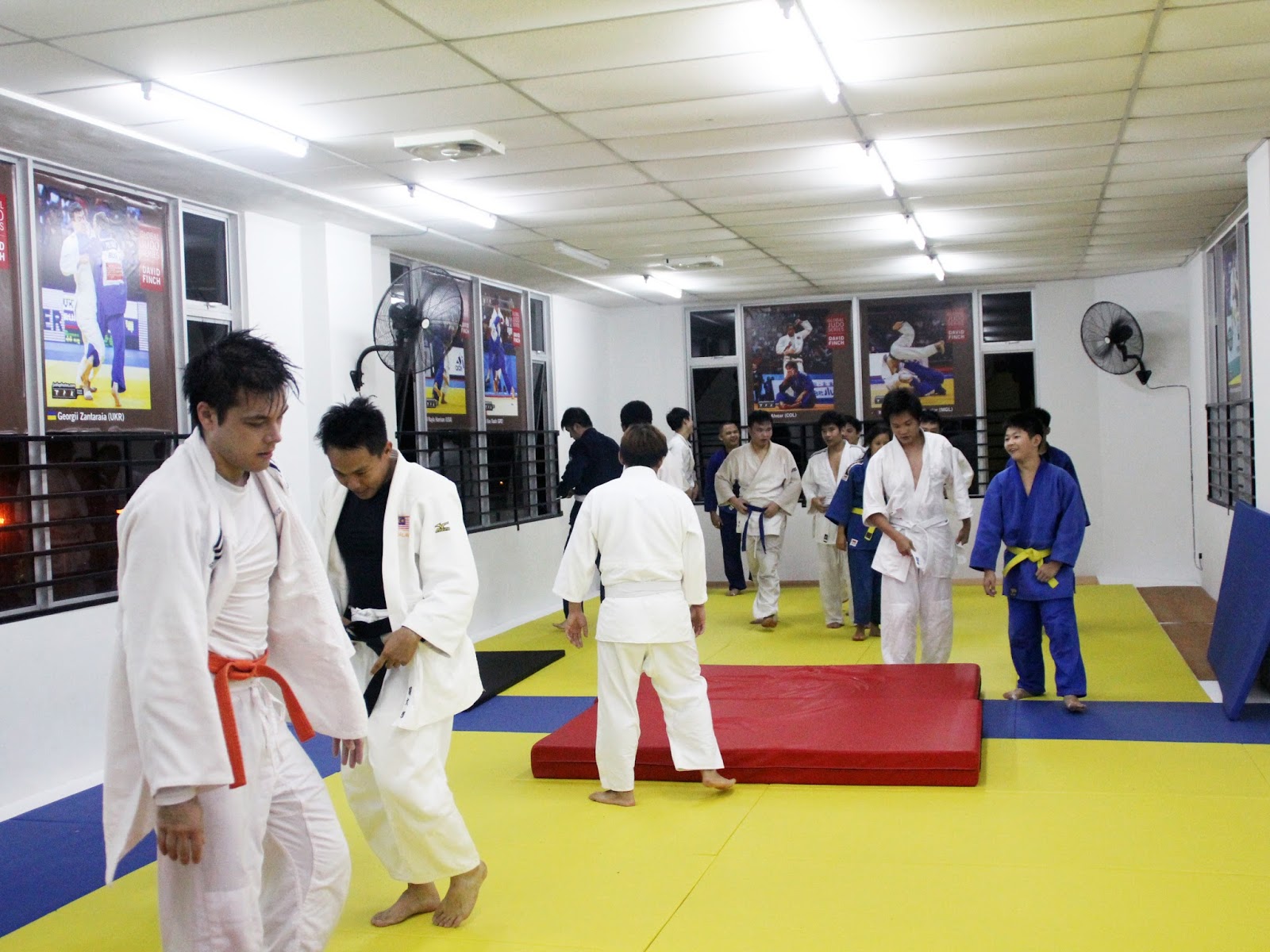 |
| The players are exhausted. They've been through circuit training, newaza drills and throwing drills for two hours now. But we are only 2/3 through. There's still randori! (Video clips of that can be seen on our Facebook Page). |
 |
| After all that hard training, the players need a sports massage. I ask everybody to partner up and give each other a massage, led by Aishah. |
 |
| I think this is necessary or the players will all be stiff and sore the next day. It's also a good way to care for your fellow judo player. |
 |
| Little Suan Wah, our youngest member at 12 years old (he insists on joining the adult class), helps Zaki out with some stretching. |
 |
| As usual, we end the session with a circular bow. We had a fantastic turnout today -- far better than I had expected and everybody gave it their all -- 100% all the way. This is what a good training session is all about. |
 |
| Everybody looks so upbeat and fresh still... but they've actually been on the mat for slightly over three hours -- of non-stop training except for some water breaks. |
 |
| You can tell everybody is totally spent. Every ounce of energy has been expended during practice. |
 |
| But the players still muster enough energy to help wipe the mats. There was a lot of sweat tonight so it's important to wipe the mats clean. |
 |
| I told them: "This is our club. If we don't take care of it, who will?" So everybody does their little bit. |
 |
| Cleaning the mats together also helps to foster team spirit and a sense of bonding. They train together and they also clean up the dojo together. Afterwards, they makan and have some drinks together. |


